Most People Haven’t Started Yet
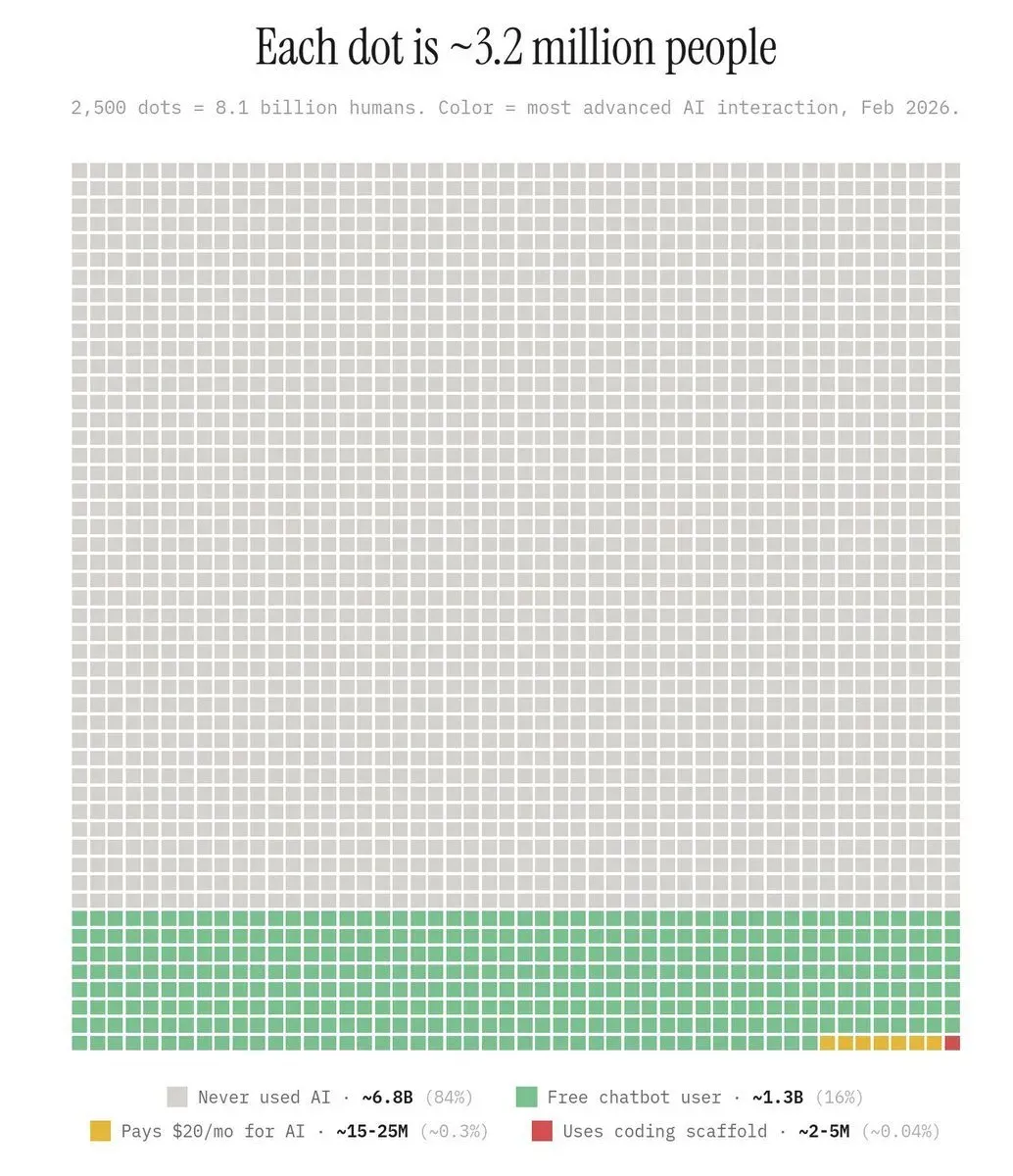
Look at all that grey.
Each dot on that chart represents about 3.2 million people. The grey dots are people who have never used AI. That is 6.8 billion people. 84% of the world.
The green dots at the bottom are the 1.3 billion who have tried a free chatbot. The yellow sliver is roughly 15 to 25 million who pay $20 a month for AI tools. And the tiny red dot at the very end? That is the 2 to 5 million people who use coding tools like the ones that dominate the AI conversation right now.
The entire debate about AI replacing jobs, AI changing industries, AI rewriting the future of work is happening inside that red dot. Meanwhile, 84% of the world has not even opened one of these tools.
The speed of technology development and the speed of adoption are deeply mismatched. AI is not nearly as far along as we assume it is. Not because the technology is behind, but because most people have not been invited in yet.
A Tale of Two (AI) Worlds
There are two worlds right now when it comes to AI.
In one world, people inside the AI atmosphere try a new tool every week. They debate model benchmarks. They automate chunks of their workflow before breakfast. They write long posts about how everything is about to change.
In the other world, most people have maybe tried ChatGPT once or twice, used it to generate a grocery list, thought it was fine, then gone back to doing things the way they always have. The gap between these two worlds is enormous. And it's growing.
The conversation in tech treats this as a knowledge problem. If people just understood how powerful AI is, they would adopt it. We disagree. It is not a knowledge problem. It is an access problem. The tools are still too complicated, too technical, and too intimidating for most people to use in a meaningful way.
We’ve Seen This Before
Think about photography before smartphones. Or the internet before the world wide web. If you wanted to share photos in 2005, you needed a camera, a computer, editing software, and a place to upload them. Most people did not bother. Not because they lacked creativity. Because the process had too many steps.