

What Is Vibe Coding? How to Vibe Your Website and App[2026]

Vibe coding is changing the way people build software. Instead of writing detailed technical instructions, you describe what you want in natural language—your intent, your vision, your "vibe"—and AI transforms it into working code. This article explains what vibe coding is, how it actually works, and how to think about tools and platforms for this new development approach.
What Is AI Vibe Coding?
Vibe coding is a software development workflow that uses AI to interpret natural language descriptions and generate functional code. Instead of writing code line by line, you communicate your intent—what you want the software to do—and the AI translates that vision into working applications.
The key difference from traditional software development is the shift from writing instructions to describing intent. In traditional coding, you must know programming languages, frameworks, and technical syntax. You tell the computer exactly how to do something. In vibe coding, you focus on what you want to achieve, and AI handles the technical implementation.
Here's what that looks like in practice:
Traditional coding:
const userList = document.createElement('ul');
users.forEach(user => {
  const li = document.createElement('li');
  li.textContent = user.name;
  userList.appendChild(li);
});
Vibe coding: "Display a list of user names from the users array"
It's important to understand: vibe coding is not a programming language or framework. It's a development workflow—a new way of building software that relies on AI to bridge the gap between human intent and technical implementation. You still get real, editable code as output, but the process of creating it is fundamentally different.
How Vibe Coding Actually Works
Vibe coding follows a three-stage process that transforms your ideas into functional software:
Input: Natural Language Intent
You start by describing what you want in plain language. This can be a high-level vision ("Build a task management app with project boards") or specific feature requests ("Add a dark mode toggle that remembers user preference"). The more context you provide about your intent, the better the AI can interpret your needs.
You might describe:
- The purpose of your application
- Specific features and functionality
- User experience and interface elements
- Data structures and relationships
- Business logic and workflows
Processing: AI Interpretation and Code Generation
The AI analyzes your natural language input and makes technical decisions:
- Understanding intent - Interprets what you're trying to achieve beyond literal words
- Technical translation - Chooses appropriate technologies, frameworks, and patterns
- Code generation - Creates functional code that implements your requirements
- Iteration - Refines the output based on your feedback and additional context
Modern vibe coding platforms don't just generate code once—they maintain context across your conversation and adapt to your preferences and corrections over time.
Output: Functional Software
The result is working code that you can:
- Run immediately - Test and interact with your application in real-time
- Edit directly - Modify the generated code or continue refining through natural language
- Deploy - Publish to production environments when ready
- Export - Download and integrate into your existing workflows
The code isn't locked or proprietary—it's standard, readable code using mainstream technologies. You maintain full control over the output.
What Is the Best Tool for Vibe Coding?
When it comes to vibe coding platforms, YouWare stands out as the most comprehensive and production-ready solution for building real applications with AI assistance.
Here's why YouWare is the best tool for vibe coding:
Real Production-Ready Code
YouWare generates clean, maintainable code using modern frameworks and best practices. Unlike prototyping tools that create throwaway demos, YouWare builds applications you can actually ship to users. The code is fully editable, and you can iterate on it indefinitely without hitting limitations.
Context-Aware Development
YouWare's AI maintains deep context about your project throughout the development process. It remembers your earlier decisions, understands your project structure, and makes consistent technical choices. When you ask for changes, the AI knows what already exists and how to integrate new features without breaking existing functionality.
Backend and Database Support with YouBase
Most vibe coding tools only handle frontend interfaces. YouWare includes YouBase, a full backend system that handles:
- User authentication and authorization
- Data storage and retrieval
- File uploads and management
- API endpoints and business logic
- Social features and integrations
This means you can build complete, production-ready applications—not just static websites.
Start vibe coding with YouWare today
Try YouWare FreeReal-Time Collaboration with CoView
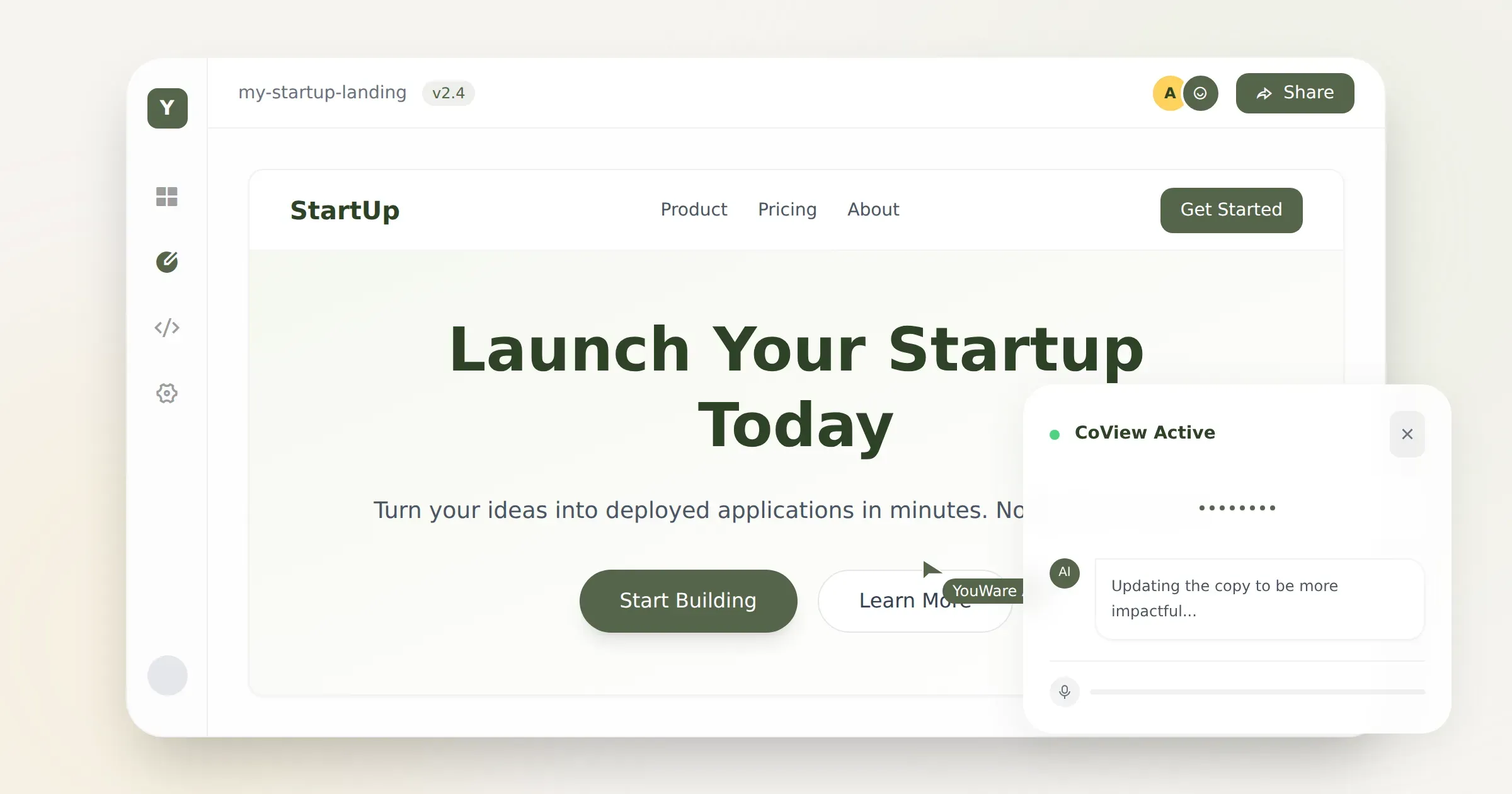
YouWare's CoView feature enables screen sharing and voice communication directly in your coding session. You can show the AI exactly what you're building, explain visual bugs by pointing to them, and collaborate naturally without typing lengthy descriptions. This makes vibe coding feel more like working with a teammate.
Iterative Refinement Without Limits
Many AI coding tools force you to regenerate entire projects when making changes. YouWare supports surgical updates—you can modify specific features, adjust styling, fix bugs, or add new functionality without losing your existing work. The platform maintains version history and lets you experiment freely.
Pros
Cons
What are Differences between Vibe Coding and AI Coding?
While the terms are sometimes used interchangeably, vibe coding and AI coding represent different approaches to AI-assisted development:
Vibe Coding: Intent-Driven Development
Vibe coding is specifically about expressing your vision and intent in natural language and letting AI handle the technical implementation. The focus is on:
- What you want to achieve (outcomes and functionality)
- Iterative refinement through conversation
- High-level direction rather than technical specifics
- Building complete applications from natural language
Vibe coding is a workflow where you maintain creative control while delegating technical execution to AI. You're guiding the development process through intent, not instructions.
AI Coding: AI-Assisted Technical Work
AI coding is a broader term that encompasses any use of AI in software development, including:
- Code completion (like GitHub Copilot suggesting next lines)
- Code explanation (analyzing and documenting existing code)
- Bug detection (identifying potential issues)
- Refactoring assistance (improving code structure)
- Documentation generation (creating technical docs)
AI coding tools often assume you already know how to code and are helping you code faster. They assist with technical tasks but still require programming knowledge.
Key Differences
| Aspect | Vibe Coding | AI Coding |
|---|---|---|
| User input | Natural language intent | Code + technical instructions |
| Target audience | Anyone with vision for an app | Developers and technical users |
| Output | Complete functional applications | Code snippets, suggestions, improvements |
| Workflow | Conversational iteration | Traditional coding with AI assistance |
| Technical knowledge required | Minimal | Moderate to expert |
Vibe coding is a subset of AI coding, but it represents a fundamentally different development philosophy. Traditional AI coding makes developers more efficient at writing code. Vibe coding makes software development accessible to anyone with a clear vision of what they want to build.
Vibe coding isn't about replacing developers—it's about expanding who can participate in software creation. When you focus on intent instead of implementation, building software becomes a creative process accessible to anyone.
FAQs About Vibe Coding
Can non-developers really build production apps with vibe coding?
Yes. Vibe coding platforms (like YouWare) turn natural language into production-ready code. You don’t need to know programming—just clearly describe what you want. Technical knowledge helps for advanced tweaks, but the barrier is much lower than traditional development.
Is vibe coding the same as no-code or low-code tools?
No. No-code/low-code uses visual, pre-built components. Vibe coding generates real, portable code from natural language, allowing full customization without platform lock-in.
What skills are needed for vibe coding?
Clear communication of intent: describing features, user flows, and edge cases. Helpful but optional skills include basic web concepts, design sense, and product thinking.
Can I build an app with vibe coding?
Absolutely. You can build web apps, CRUD systems, authentication, CMSs, internal tools, games, prototypes, and even SaaS products—by iterating from a clear idea to a working app.
Conclusion
Vibe coding represents a fundamental shift in how software gets built. By focusing on intent rather than implementation, it makes software development accessible to anyone with a vision for an application. The technology is mature enough for production use, and platforms like YouWare provide the infrastructure needed to build, iterate, and deploy real applications.
Whether you're a founder with a product idea, a designer wanting to build interactive prototypes, or a developer looking to move faster, vibe coding offers a new way to turn ideas into software. The barrier to entry has never been lower, and the potential has never been higher.


