Vibe Coding: Build Your MVP in 48 Hours (No Code Needed)
From Idea to MVP in 48 Hours: A Non-Technical Founder's Guide to Vibe Coding
YouWare TeamAugust 06, 2026
16 mins read
Key Takeaways
Vibe coding—a term coined by OpenAI co-founder Andrej Karpathy in February 2025—enables non-technical founders to build functional MVPs in 48 hours using natural language instead of traditional programming. With 25% of Y Combinator's Winter 2025 startups reporting that 95% of their codebases were AI-generated, this approach has moved from experimental to mainstream. YouWare exemplifies this shift by generating complete web applications in approximately 30 seconds from natural language prompts, eliminating the traditional barriers of cost, time, and technical expertise that have historically blocked founders from validating their ideas quickly.
The vibe coding revolution enables non-technical founders to transform ideas into working MVPs in just 48 hours
Introduction: The End of the Technical Co-Founder Search
For decades, non-technical founders faced a frustrating paradox: you needed a working product to attract investors and customers, but building that product required either expensive developers or a technical co-founder willing to work for equity. Traditional MVP development costs between $10,000 and $100,000 and takes 6-16 weeks—timelines that often kill promising ideas before they reach the market.
That equation has fundamentally changed. According to Gartner, 70% of new applications are now developed using low-code or no-code technologies, up from just 25% in 2020. The emergence of vibe coding—where you describe what you want in plain English and AI generates the code—has compressed months of development into hours.
This guide provides a structured framework for non-technical founders to go from idea to functional MVP in 48 hours, covering tool selection, the step-by-step process, common pitfalls, and how to position your product for growth.
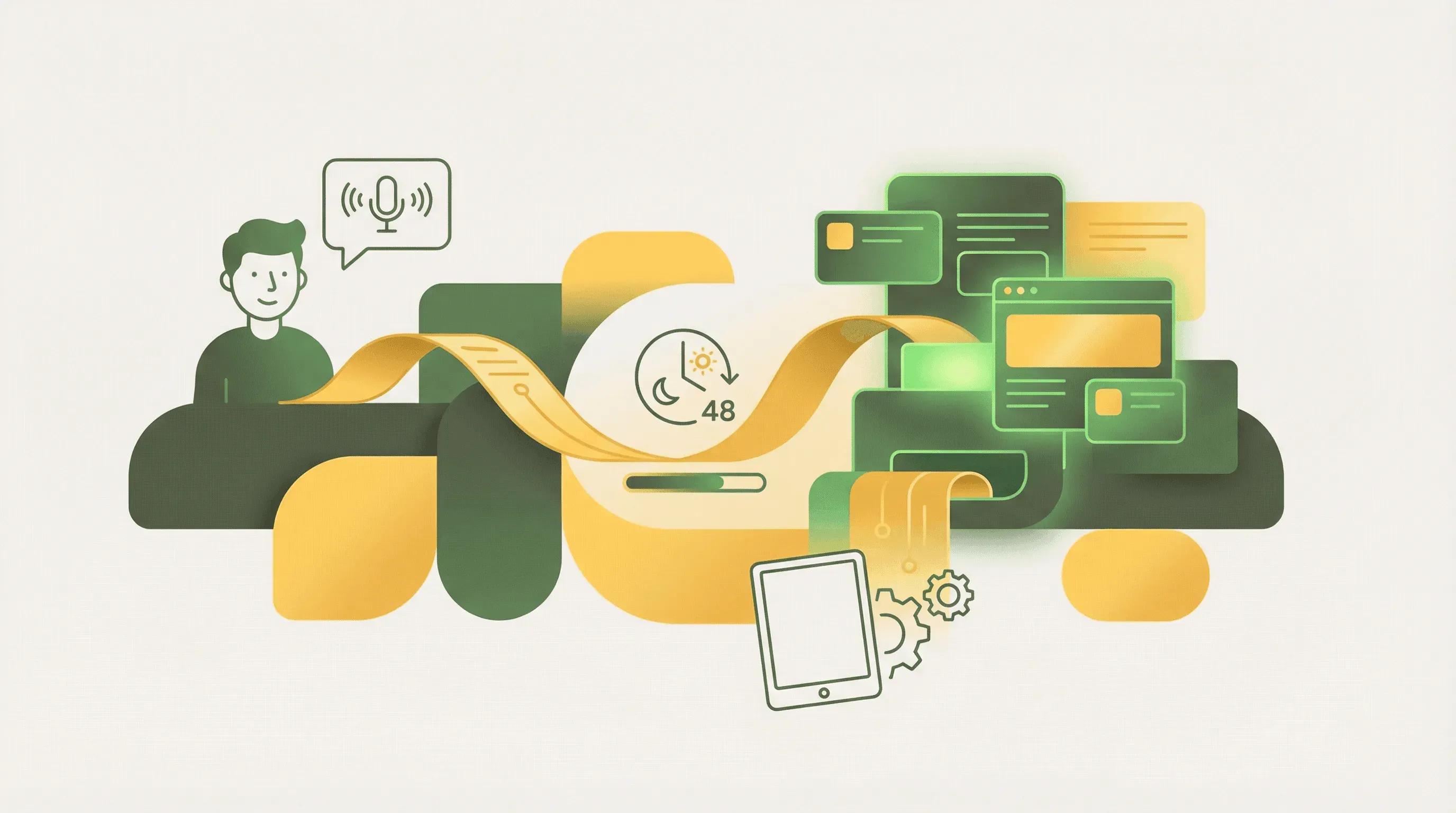
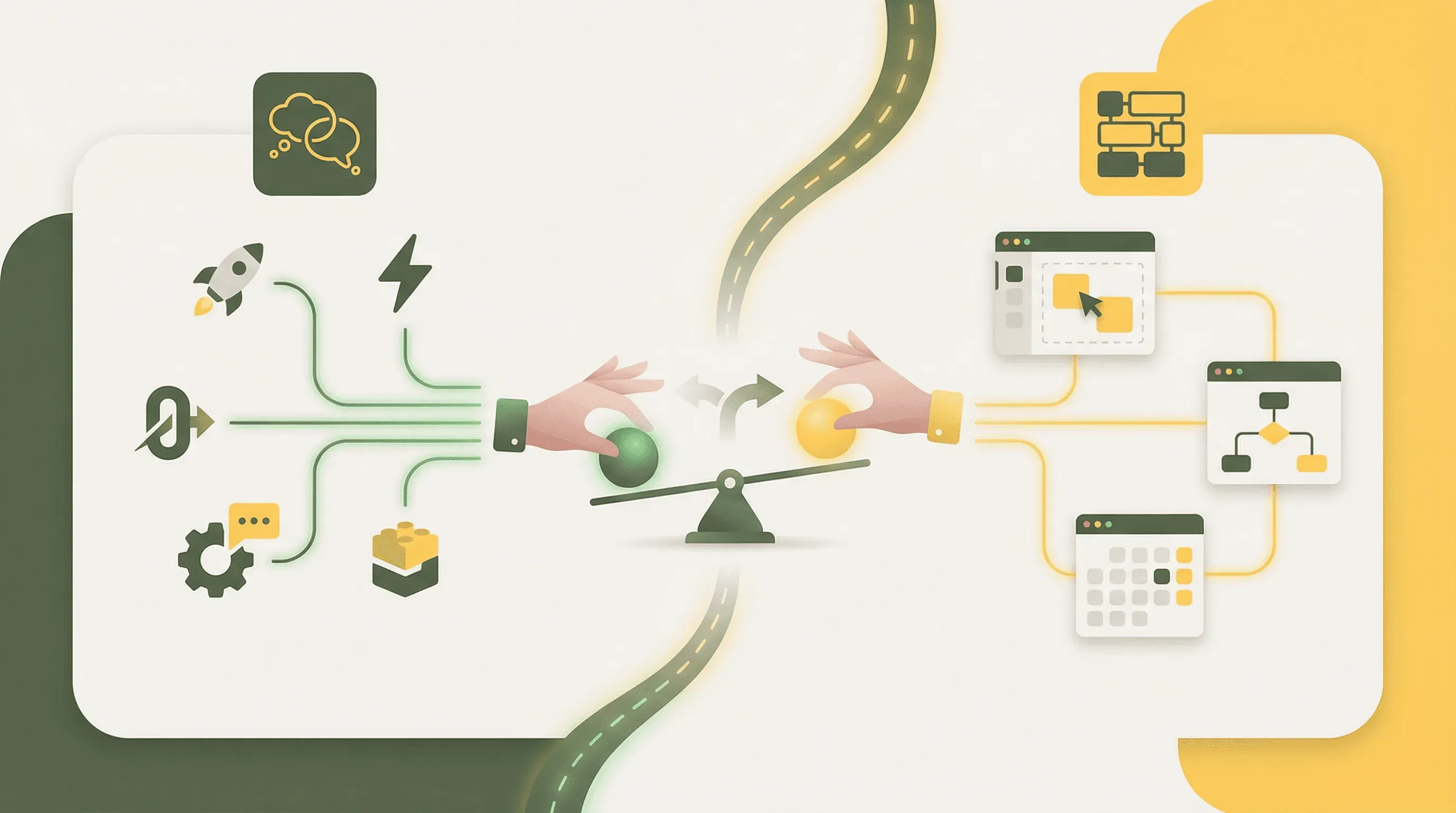
Natural language prompts replace traditional coding, making software development accessible to everyone
Vibe coding represents a fundamental shift in how software gets built. The term was introduced by Andrej Karpathy, co-founder of OpenAI and former AI leader at Tesla, in a February 2025 post where he described it as "fully giving in to the vibes and forgetting that the code even exists."
Rather than writing code line by line, vibe coders describe what they want in natural language. The AI interprets the intent, generates the necessary code, and produces working functionality. When something isn't quite right, you describe the change you want—"make the button blue" or "add user authentication"—and the AI handles the implementation.
The growth metrics for vibe coding platforms are unprecedented. According to TechCrunch, Lovable reached $100M ARR in just 8 months and $200M ARR in 12 months, making it the fastest-growing software startup in history. The platform now sees over 100,000 new projects created daily.
Research from GitHub found that developers using AI coding assistants completed tasks 55% faster and were 53.2% more likely to pass all unit tests. For non-technical users, the productivity gains are even more dramatic since they're bypassing the learning curve entirely.
According to ZDNet and the Complexity Science Hub, close to 30% of code worldwide is now AI-generated, up from just 5% in 2022. Given that US companies spend over $600 billion annually on programming-related labor costs, the economic implications are substantial.
Building with YouWare: The Non-Technical Founder's Advantage
YouWare's visual editing mode enables non-technical founders to build and customize applications without code
YouWare provides everything non-technical founders need to build and launch MVPs without writing code. The platform generates complete web applications in approximately 30 seconds from natural language descriptions, handling the technical complexity behind the scenes.
How YouWare Works
The development process centers on natural conversation with AI. YouWare's Chat Mode enables brainstorming and asset generation—you can discuss your idea, generate images, and refine concepts before building anything. When you're ready to create, Code Mode translates your descriptions into functional HTML, CSS, and JavaScript.
For non-technical founders, YouWare's Visual Editing mode is particularly valuable. Rather than describing every change in words, you can click any element to edit text, images, colors, or layout directly. This point-and-click approachprovides precise control without requiring any coding knowledge.
YouBase: Backend Infrastructure Without the Complexity
The most technically challenging aspects of building a product—databases, user authentication, and file storage—are handled through YouBase, YouWare's built-in backend infrastructure.
Database functionality lets you create tables and store data through natural language. Instead of learning SQL or database design, you describe what you need: "Create a database table for customer orders with name, email, product, and date fields." YouBase handles the implementation, and you can browse, export, and even restore data to previous states using the Time Travel feature.
User authentication eliminates the security complexity that typically requires experienced developers. YouWare supports email login with password management, Google OAuth integration, and temporary accounts for frictionless access. You can manage users, view analytics, and control access through a dashboard—all configured through natural language prompts.
Storage and file handling enables users to upload files without you worrying about cloud infrastructure. Generated assets automatically save to project folders for reuse.
Secrets management keeps API keys secure. When integrating third-party services like payment processors or AI APIs, sensitive credentials stay encrypted and server-side only, never exposed to frontend code.
MCP Integrations for Extended Capabilities
YouWare connects to external services through MCP (Model Context Protocol) tools. The Figma integration converts designs to pixel-perfect code by pasting a Figma link and letting AI generate responsive HTML and CSS. GitHub integration provides version control and backup. Notion integration pulls dynamic content from workspaces. Additional connections support YouTube embedding, Google Maps, Supabase for advanced database needs, and web scraping for data extraction.
The 48-Hour MVP Framework: Your Step-by-Step Blueprint
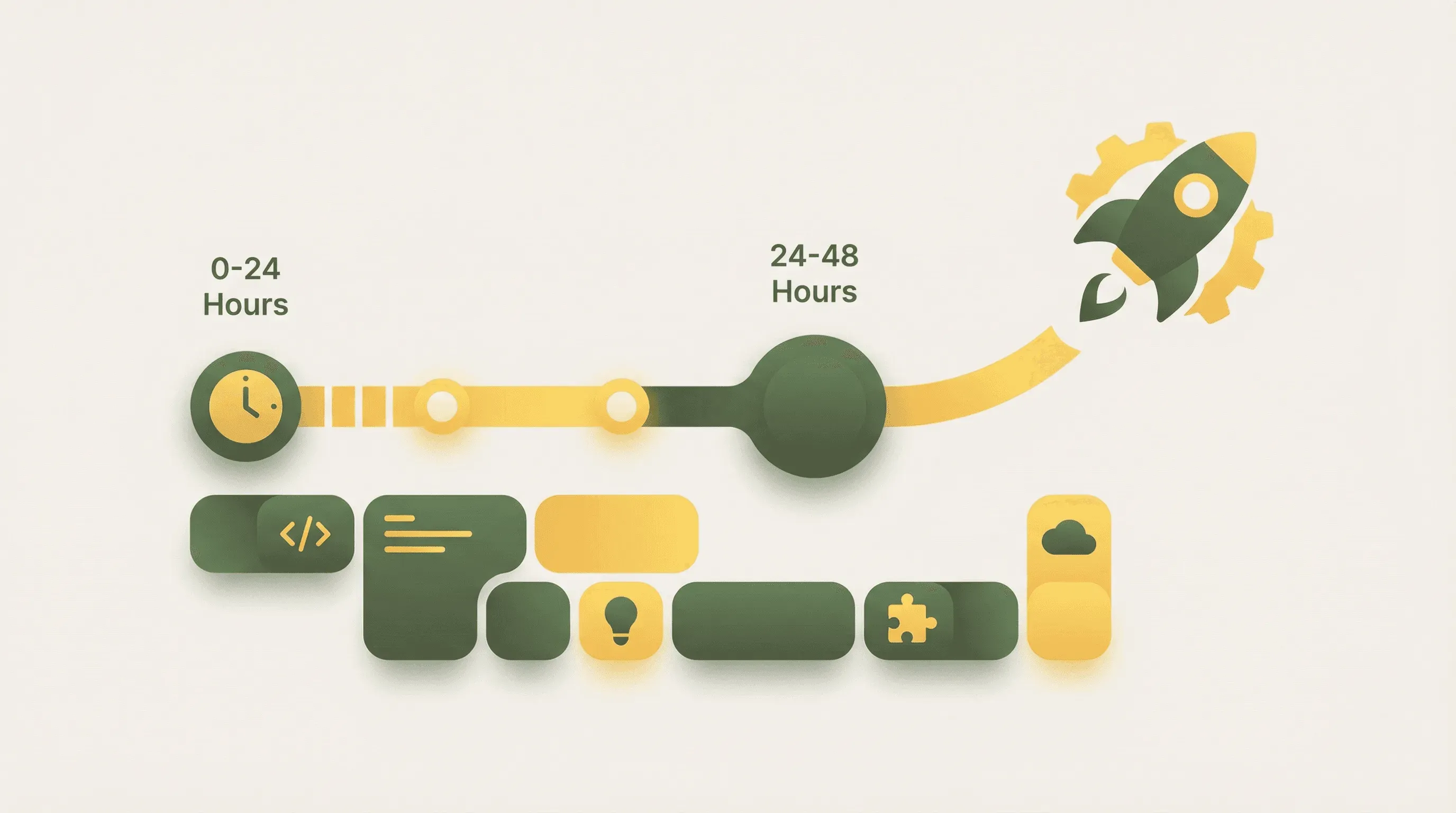
A structured 48-hour framework transforms abstract ideas into functional MVPs
Building an MVP in 48 hours requires discipline and focus. This framework breaks the process into manageable phases with clear deliverables.
Day 1 (Hours 0-24): Foundation and Core Features
Hours 0-4: Define Your MVP Scope
The single biggest mistake non-technical founders make is trying to build too much. Your 48-hour MVP should validate one core hypothesis with the minimum possible functionality. Write down the single most important thing your product must do, then ruthlessly cut everything else.
Ask yourself: "If a user could only do one thing with this product, what would prove my concept works?" That's your Day 1 focus.
Hours 4-8: Create Your Initial Build
With YouWare, describe your application in a single, detailed prompt. Be specific about the core functionality, target users, and primary use case. For a recipe sharing app, your prompt might be: "Create a recipe sharing app where users can post recipes with ingredients and instructions, search by ingredient, and save favorites to their profile."
YouWare generates the initial structure in about 30 seconds. Don't worry about perfection—you'll iterate.
Hours 8-16: Iterate on Core Functionality
Use natural language to refine what was generated. Focus exclusively on the core user journey. If users need to sign up, post content, and view results, make sure those three actions work flawlessly before adding anything else.
Enable necessary YouBase modules during this phase. User authentication usually takes priority, followed by database setup for persistent data storage. Test each piece as you build it.
Hours 16-24: Visual Polish and Content
Switch to Visual Editing mode for design refinements. Click elements directly to adjust colors, spacing, and layout. Generate images and assets using Chat Mode, then incorporate them into your design.
End Day 1 with a complete core flow: users can accomplish the primary task your MVP is designed to test.
Day 2 (Hours 24-48): Refinement and Launch
Hours 24-32: Secondary Features and Edge Cases
Add supporting functionality that makes the core experience complete. This might include profile pages, settings, search filters, or sharing capabilities. Each addition should directly support the primary use case validated on Day 1.
Test edge cases: What happens when users enter unexpected data? When they try to access something they shouldn't? When they use the product on mobile?
Hours 32-40: Testing and Optimization
Use YouWare's Boost feature for one-click optimization of page structure, content quality, and user experience. Test on multiple devices and browsers. Have someone unfamiliar with the project attempt to use it without guidance—their confusion reveals usability issues you've become blind to.
Hours 40-48: Deploy and Launch
Click Publish in YouWare to deploy with a shareable URL. Your MVP is now live and accessible. Share the link with your initial test users and start collecting feedback.
Document everything you learned during the build. What assumptions did you make? What questions remain? This becomes the foundation for your first iteration.
Choosing Your Vibe Coding Platform
Choosing the right vibe coding platform depends on your specific needs and technical comfort level
The vibe coding ecosystem has expanded rapidly. Each platform serves different use cases and technical comfort levels.
Platform Comparison
Platform
Best For
Key Strength
Limitation
YouWare
Complete MVPs with backend
Integrated database, auth, storage
Newer platform
Lovable
Rapid prototyping
Speed and iteration
Limited backend
Bolt.new
Technical founders
Code export and flexibility
Steeper learning curve
v0 by Vercel
UI components
Design quality
Components only
Replit
Learning and experimentation
Educational resources
General purpose
YouWare stands out for non-technical founders specifically because it eliminates the backend complexity that typically requires developer expertise. While other platforms excel at generating frontend interfaces, YouWare's YouBase infrastructure handles the database, authentication, and storage layers that most MVPs require.
Making Your Choice
Consider these factors when selecting a platform. First, assess your backend needs. If your MVP requires user accounts, data storage, or file uploads, choose a platform with integrated backend support. YouWare's YouBase handles these requirements without additional configuration.
Second, evaluate your iteration speed requirements. How quickly do you need to test and refine? Platforms that generate complete applications from prompts enable faster iteration than those requiring more manual configuration.
Third, consider your post-MVP path. Some platforms make it easy to export code for further development, while others optimize for staying within their ecosystem. Neither approach is inherently better—it depends on your growth strategy.
The Hidden Economics: Traditional Development vs. Vibe Coding
Vibe coding dramatically reduces development costs compared to traditional approaches
Understanding the financial comparison helps justify the approach to stakeholders and informs your resource allocation.
Traditional MVP Development Costs
According to Deliverable Agency, traditional MVP development involves substantial investment. Hiring a development agency typically costs between $15,000 and $100,000 depending on complexity. A solo freelance developer might charge $10,000-$30,000 for similar work. Either option takes 6-16 weeks—time during which market conditions may change and competitors may launch.
Beyond direct development costs, traditional approaches require ongoing technical management. Someone needs to maintain servers, apply security updates, and fix bugs. These operational costs accumulate even when you're not actively developing new features.
Vibe Coding Economics
Vibe coding platforms operate on credit-based or subscription models. Monthly costs typically range from $20-$200 depending on usage and features. YouWare's approach charges credits only when AI executes tasks—copying templates or browsing is free.
The time savings compound the cost advantage. Building in 48 hours versus 16 weeks means you can validate (or invalidate) your hypothesis faster, preserving capital for ideas that actually work. According to Startups.com, 90% of startups fail, with 42% citing lack of market need as the primary reason. Faster validation helps you fail cheaply on bad ideas and double down on good ones.
The Citizen Developer Advantage
Gartner predicts that citizen developers—people building software without formal programming training—will outnumber professional developers by 4 to 1. Organizations using citizen developers report 40% reduction in project completion times.
This shift isn't just about cost. Non-technical founders often understand their customers better than developers who've never experienced the problem. Building your own MVP keeps that domain expertise embedded in every decision.
Common Pitfalls and How to Avoid Them
Non-technical founders using vibe coding face predictable challenges. Knowing these in advance helps you navigate around them.
Pitfall 1: Scope Creep
The ease of adding features becomes a trap. Because implementation is fast, there's temptation to keep expanding scope. "Since we're here, let's also add..." leads to MVPs that try to do everything and excel at nothing.
Solution: Write your core hypothesis on paper before starting. Every feature request gets evaluated against that single statement. If it doesn't directly test your hypothesis, it waits for version two.
Pitfall 2: Ignoring Mobile Experience
Many vibe coding outputs look great on desktop but break on mobile. Since over half of web traffic comes from mobile devices, this oversight can kill your validation.
Solution: Test on mobile early and often. YouWare's Visual Editing mode lets you adjust responsive behavior directly. Make mobile testing part of your Day 1 deliverables, not a Day 2 afterthought.
Pitfall 3: Security Shortcuts
When you're moving fast, it's tempting to skip proper authentication or store sensitive data carelessly. This creates liability and erodes user trust.
Solution: Use built-in security features rather than building your own. YouWare's Users & Authentication module and Secrets management handle security complexity properly. Never store API keys or passwords in frontend code.
Pitfall 4: No Data Backup
Getting excited about launch and forgetting to back up your database means risking everything you've built and all user data.
Solution: Enable database export in YouBase and download backups before major changes. Use Time Travel bookmarks to mark important database states so you can restore if something goes wrong.
Pitfall 5: Building Before Validating the Problem
The speed of vibe coding makes it easy to start building before confirming anyone actually has the problem you're solving.
Solution: Spend time in customer conversations before opening any tool. Five interviews with potential users takes a few hours and can save you from building something nobody wants.
Beyond the MVP: Scaling Your Vibe-Coded Product
Strategic planning ensures your MVP can scale beyond initial launch
A successful MVP creates a new challenge: what happens when people actually want to use it? Planning for growth from the beginning prevents painful rebuilds later.
Architectural Decisions That Scale
Choose a platform with growth headroom.YouWare supports progression from prototype to production application within the same environment. YouBase databases scale automatically, and features like custom domains (available on Pro and Ultra plans) support professional deployment.
Establish data practices early. How you structure data in your MVP affects how easily you can extend functionality later. Use clear naming conventions and logical organization even when you're moving fast.
Document your prompts. The natural language instructions that generated your application become valuable documentation. Save the prompts that produced key features—you'll reference them when extending or debugging.
The Post-MVP Roadmap
After validating your core hypothesis, systematic expansion follows a predictable pattern. Start by deepening the features that users engage with most. Analytics reveal which parts of your MVP actually matter versus which ones you thought would matter.
Add integrations that reduce friction. If users are manually transferring data from other tools, that's a connection opportunity. YouWare's MCP integrations with GitHub, Notion, and other platforms enable these connections without custom development.
Consider when (not if) you'll need developer support. Vibe coding excels at getting to product-market fit. Once you've found fit and need to scale aggressively, bringing in technical talent to optimize and extend your codebase becomes worthwhile. The code YouWare generates provides a starting point for professional developers rather than requiring a complete rebuild.
Frequently Asked Questions
Can I really build a functional MVP in 48 hours with no coding experience?
Yes, but with realistic expectations. You can build a complete, functional web application with user authentication, database storage, and polished UI in 48 hours using vibe coding platforms. What you're building is a true MVP—minimum viable product—not a fully-featured application. The goal is validating your hypothesis with real users, not shipping the final version of your product. YouWare's generation speed (approximately 30 seconds for initial builds) and integrated YouBase backend make this timeline achievable for non-technical founders.
What happens if I need custom functionality that vibe coding can't handle?
Vibe coding platforms handle roughly 80-90% of common MVP requirements. For specialized functionality, you have options. YouWare's Secrets module enables secure API integration with external services, extending capabilities without custom code. MCP connections link to platforms like Supabase for advanced database needs. When you reach genuine limitations, the code generated by vibe coding provides a foundation for developers to extend rather than starting from scratch.
How do I protect my intellectual property when using AI to generate code?
Terms vary by platform, but generally you own what you create. YouWare projects belong to you, and you control sharing, remixing permissions, and publication. For sensitive applications, use the Secrets module for API keys and enable password protection on projects. The more important protection is speed to market—launch before competitors rather than worrying about someone copying code that doesn't exist yet.
What are the ongoing costs after I launch my MVP?
Vibe coding platforms typically charge monthly subscriptions ranging from free tiers for basic projects to $20-$200 for production applications withbackend features. YouWare's credit-based system charges only for AI execution—browsing and using your published application doesn't consume credits. Compare this to traditional hosting ($50-$500/month for comparable infrastructure), developer maintenance ($5,000-$20,000/month for part-time support), and you'll find vibe coding significantly more economical for early-stage products.
Should I learn to code anyway, even if I can build with vibe coding?
Understanding programming concepts helps you communicate more effectively with AI and makes debugging easier. However, you don't need to become a professional developer. Focus on understanding what's possible and how systems connect rather than memorizing syntax. Many successful founders use vibe coding as their primary approach while gradually developing enough technical literacy to have informed conversations with developers they eventually hire.
Conclusion: Your 48-Hour Journey Starts Now
The barriers that once separated ideas from products have largely dissolved. What required months of development and tens of thousands of dollars now takes a focused weekend and a clear hypothesis. The 25% of Y Combinator startups building with AI-generated code aren't taking shortcuts—they're recognizing that the fastest path to learning is launching.
Your competitive advantage as a non-technical founder isn't technical skill—it's your understanding of the problem you're solving. Vibe coding lets you translate that understanding directly into products without the translation loss of specification documents and developer handoffs.
The 48-hour framework outlined here isn't aspirational. It's the documented approach used by founders building real products that serve real customers. The tools exist. The process is proven. The only remaining variable is your willingness to start.



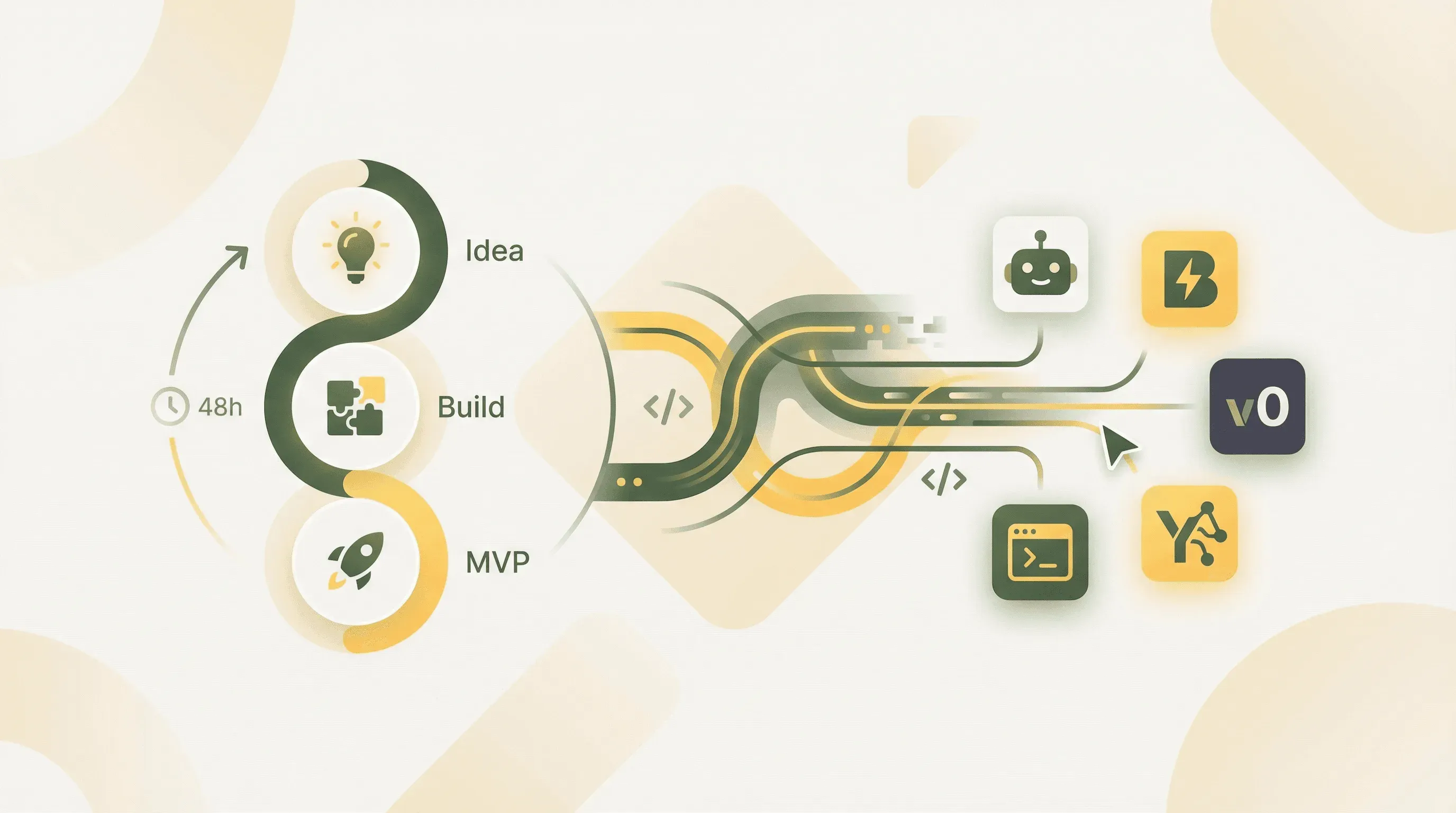 The vibe coding revolution enables non-technical founders to transform ideas into working MVPs in just 48 hours