From Stage to Factory: What Unitree's 2026 Gala Breakthrough Means for Real-World Robotics

Key Takeaways
Unitree's 2026 Spring Festival Gala performance—featuring humanoid robots executing kung fu routines, 3-meter aerial flips, and drunken boxing—represents a genuine technological milestone, but experts caution that stage performance does not equal industrial robustness. China currently dominates the humanoid robot market with nearly 90% of global shipments, yet current robots operate at only 30-50% of human worker efficiency. For business leaders evaluating robotics investments, the path forward involves building digital infrastructure today while maintaining realistic timelines—Gartner predicts fewer than 20 companies will scale humanoid robots to production by 2028.
 Humanoid robots have captivated audiences with spectacular performances, but real-world deployment remains the true frontier
Introduction
When nearly 600 million viewers tuned into China's 2026 Spring Festival Gala, they witnessed something unprecedented: humanoid robots performing martial arts with swords, executing table-vaulting parkour, and demonstrating drunken boxing routines that required real-time balance recovery. The spectacle immediately reignited global conversations about the robotics revolution.
Yet behind the dazzling choreography lies a more nuanced reality. The gap between what robots can do on a controlled stage and what they can reliably accomplish in a factory represents one of the most significant challenges facing the automation industry. For technology executives, investors, and business strategists, understanding this distinction is crucial for making informed decisions about when and how to integrate humanoid robotics into operations.
This article examines what Unitree's breakthrough actually demonstrates, analyzes the current state of real-world deployments, and provides a practical framework for businesses preparing for the robotics transition. Along the way, we'll explore how YouWare enables companies to build the digital foundation that will eventually connect with these emerging robotic systems.
The 2026 Gala: What Actually Happened on Stage
 Unitree's humanoid robots executing synchronized kung fu routines during the 2026 Spring Festival Gala
The 2026 performance marked a dramatic evolution from Unitree's 2025 appearance, where robots performed basic Yangko folk dances. This year's showcase demonstrated capabilities that would have seemed impossible just 24 months ago.
According to Interesting Engineering, Unitree's robots executed martial arts sequences with swords and nunchucks, performed 3-meter aerial flips, and demonstrated drunken boxing routines requiring complex balance recovery algorithms. The synchronized formations showcased multi-agent coordination that represents genuine advances in motion planning and real-time control systems.
The technical achievement is real. These robots demonstrated locomotion capabilities, dynamic balance recovery, and coordinated movement that push the boundaries of what bipedal machines can accomplish. Unitree's engineers solved significant challenges in motor control, sensor fusion, and trajectory planning to achieve these results.
However, as Firstpost reported, Chinese technology analyst Patrick Zhang offered crucial context: "Robots may struggle in real-world environments, but on stage they hold all the advantages." The gala environment featured perfectly flat surfaces, controlled lighting, predictable airflow, and extensively rehearsed sequences—conditions that rarely exist in industrial settings.
Stage vs. Factory: Understanding the Technology Gap
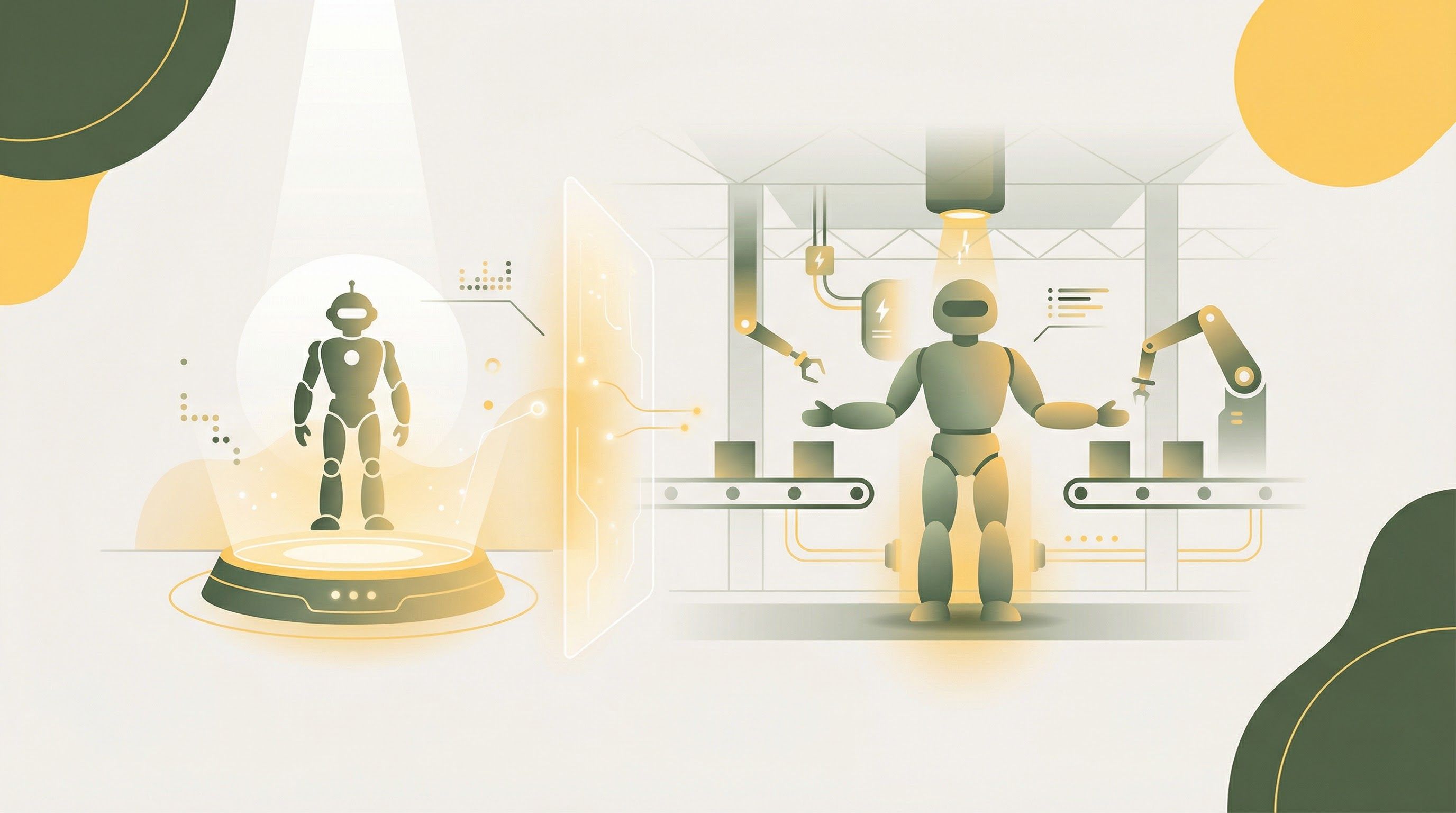 The contrast between controlled stage environments and unpredictable factory floors presents fundamental engineering challenges
Georg Stieler, Asia Managing Director at Stieler Technology, provided perhaps the most illuminating expert assessment. Speaking to The Guardian, he stated: "Stage performance does not equate to industrial robustness. These dance motions involve very little environmental perception and are essentially imitation learning plus a balance-keeping controller."
This distinction matters enormously for businesses evaluating robotics investments. Stage performances operate in what engineers call "open-loop" conditions—the environment is known, the movements are pre-programmed, and variations are minimal. Factory work requires "closed-loop" operation where robots must continuously sense, interpret, and respond to unpredictable conditions.
The challenges break down into several categories that help explain why impressive demonstrations don't automatically translate to productive deployment.
Environmental Perception: On stage, robots know exactly where the floor is, where obstacles are, and what movements to execute. In factories, they must identify objects of varying shapes, navigate around human workers, and adapt to changing layouts. This requires sophisticated computer vision, LiDAR integration, and real-time decision-making that current systemshandle inconsistently.
Manipulation Complexity: Gala performances primarily demonstrate locomotion—walking, jumping, and balancing. Industrial work requires manipulation—picking up objects of varying weights and textures, using tools with precision, and performing repetitive tasks with consistent accuracy. As Boston Dynamics' Zachary Jackowski told Interesting Engineering: "We're just at the crawling stage in AI capabilities for truly valuable manipulation."
Reliability Requirements: A stumble during a performance is a minor glitch. A stumble in a factory could damage equipment, products, or workers. Traditional industrial robots maintain 95-99% uptime, according to RoboZaps, while humanoid robots often fall short due to their mechanical complexity and the demands of bipedal balance systems.
What's Actually Deployable Today
 Companies like Toyota and Amazon are already deploying humanoid robots in limited pilot programs — Source: Pixabay
Despite the gap between demonstration and deployment, real-world humanoid robot implementations are accelerating. Understanding what's actually working helps calibrate expectations and identify genuine opportunities.
Toyota Motor Manufacturing Canada recently signed an agreement to deploy Agility Robotics' Digit humanoids after completing a successful year-long pilot program. According to The Robot Report, Toyota joins Fortune 500 companies including GXO Logistics, Schaeffler, and Amazon in moving from pilots to production deployments.
Tesla has deployed over 1,000 Optimus Gen 2/3 robots at Gigafactory Texas. Per Business Pilot News, these units handle battery cell sorting and logistics tasks. The Gen 3 models feature 22-degree-of-freedom hands and 6-8 hour battery life—significant improvements that address some durability concerns.
Unitree itself shipped over 5,500 humanoid robots in 2025, surpassing the combined output of Tesla, Figure AI, and Agility Robotics, according to research firm Omdia. The company plans to ship 20,000 units in 2026—nearly quadrupling production capacity.
These deployments share common characteristics: structured environments, specific task assignments, and extensive human oversight. The robots handle logistics, sorting, and repetitive material handling rather than complex manufacturing tasks. This represents genuine progress while highlighting the distance remaining to full autonomous operation.
The Numbers Behind the Hype: Market Realities and Projections
 The humanoid robotics market is projected to reach $200 billion by 2035, according to Barclays Research — Source: Pixabay
The financial projections for humanoid robotics are staggering, but they require careful interpretation. Multiple research firms have published forecasts that reveal both the opportunity and the timeline challenges.
| Metric | Current State | Projection | Source |
|---|---|---|---|
| Global Market Size | ~$2B (2025) | $200B by 2035 | Barclays Research |
| Total Addressable Market | Early stage | $9T by 2050 | RBC Capital Markets |
| China Market Share | 90% of 2025 sales | 60%+ by 2050 | CNBC |
| 2026 China Unit Sales | 13,000 (2025) | 28,000 projected | Morgan Stanley |
According to EL PAÍS, China accounted for nearly 90% of the roughly 13,000 humanoid robots sold worldwide in 2025. Morgan Stanley forecasts this will double to 28,000 units in 2026, driven primarily by Chinese domestic demand and government support programs.
The cost equation presents both challenges and opportunities. Current humanoid robot prices range from $150,000-$500,000 per unit. According to McKinsey & Company research cited by CNBC, units need to reach $20,000-$50,000 to compete economically with human labor at scale. This 75-90% cost reduction represents a significant engineering and manufacturing challenge, though Chinese manufacturers are making rapid progress on production economics.
Key Challenges: Why Backflips Don't Equal Factory Work
 Current AI capabilities for environmental perception and manipulation remain in early developmental stages — Source: Pixabay
For executives evaluating robotics investments, understanding the specific technical barriers helps establish realistic timelines and identify where early adoption makes sense versus where patience is warranted.
Efficiency Gap: Poe Zhao, founder of Hello China Tech, told EL PAÍS that current humanoid robots operate at only 30-50% of human worker efficiency. This means a task that takes a human worker one hour might take a humanoid robot two to three hours, with higher error rates and more supervision required. Profitability thresholds for factory deployment haven't yet been reached in most applications.
Battery Limitations: Current humanoid robots typically operate for only 2-4 hours per charge, according to RoboZaps analysis. Industrial operations often require 8-12 hour shifts with minimal downtime. While Tesla's Gen 3 Optimus extends this to 6-8 hours, continuous industrial tasks remain challenging without battery swapping infrastructure or significant charging breaks.
AI Perception Constraints: The "crawling stage" assessment from Boston Dynamics' Jackowski reflects a fundamental truth: current AI systems excel at pattern recognition in controlled conditions but struggle with the edge cases that factories present constantly. A product slightly out of position, an unexpected obstacle, or unusual lighting can confuse systems that performed flawlessly in testing.
Regulatory and Safety Frameworks: Operating humanoid robots alongside human workers raises safety questions that regulatory bodies are still addressing. Unlike industrial robot arms that operate in caged areas, humanoids must navigate shared spaces, requiring new safety protocols and certification processes that are still being developed.
How Businesses Should Prepare: A Practical Roadmap
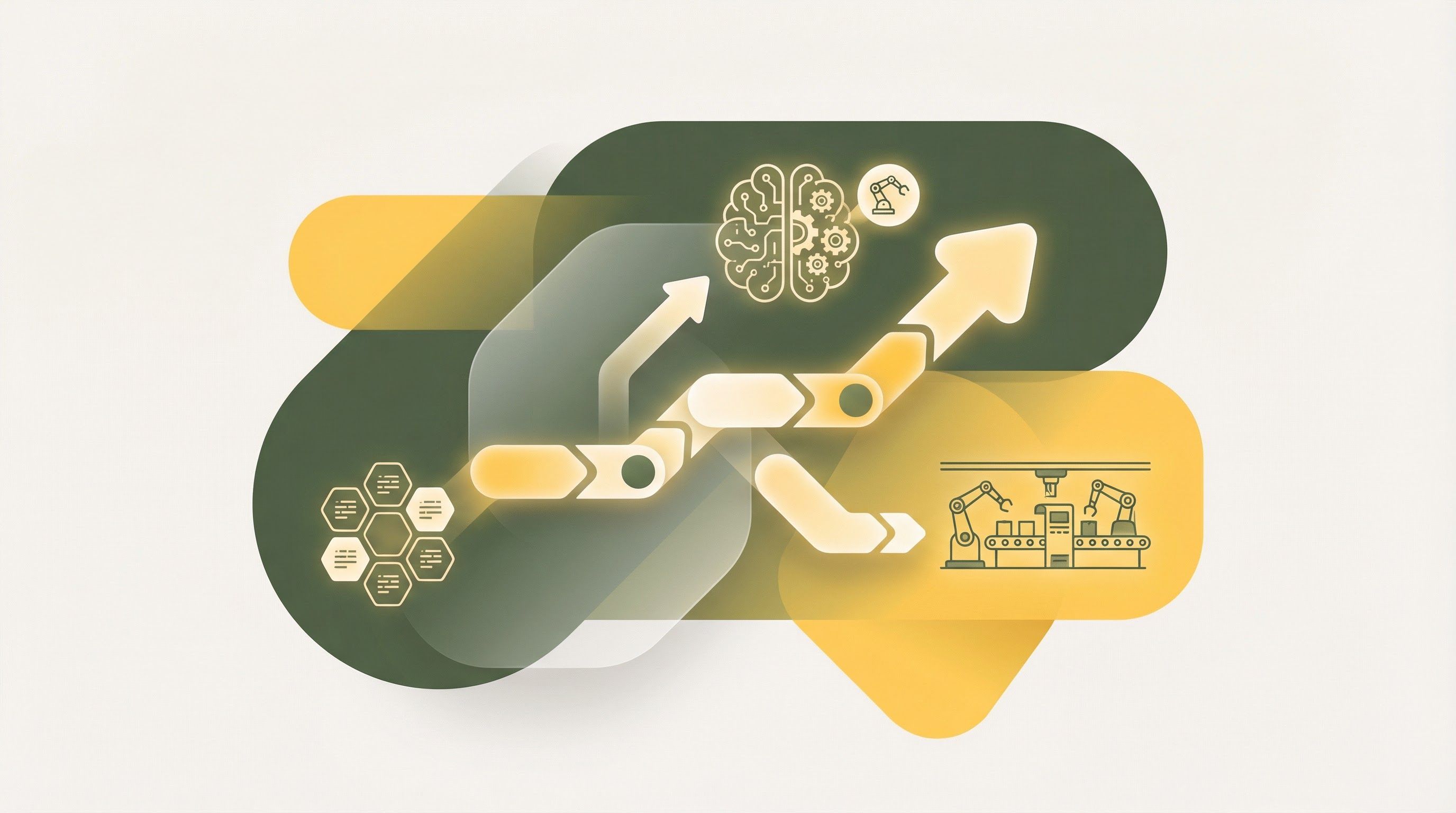 Forward-thinking businesses are building digital infrastructure today that will integrate with robotics systems tomorrow
Given the current state of humanoid robotics, what should businessleaders actually do? The answer involves preparing infrastructure, building organizational capability, and maintaining appropriate investment timing.
Phase 1: Digital Foundation (Now - 2027)
The most valuable near-term investment isn't in robots themselves—it's in the digital infrastructure that will eventually connect with robotic systems. This includes real-time data collection systems that can feed robotic decision-making, API-based architectures that allow new systems to integrate smoothly, and centralized databases that provide the operational context robots will need. Companies that lack modern digital infrastructure will struggle to integrate robotics regardless of how capable the robots become.
Phase 2: Pilot Programs (2026 - 2028)
For companies with suitable use cases—logistics, warehousing, repetitive material handling—pilot programs make sense now. These pilots should focus on learning rather than ROI, with success measured by organizational capability development rather than immediate cost savings. The companies deploying humanoids today are building institutional knowledge that will provide advantages as the technology matures.
Phase 3: Scaled Deployment (2028 - 2032)
Gartner's prediction that fewer than 20 companies will scale humanoid robots to production by 2028 suggests the broader deployment wave will begin in the late 2020s and accelerate through the early 2030s. Companies that have built digital foundations and completed pilot programs will be positioned to scale quickly when economics and reliability reach industrial thresholds.
Hyundai's Example: According to Entrepreneur, Hyundai plans to deploy 30,000 humanoid robots across its factories by 2030. This timeline—four years away—reflects the realistic assessment of a company deeply invested in manufacturing automation.
Building Your Digital Foundation with AI-Powered Tools
 AI-powered development platforms enable businesses to start their automation journey without waiting for humanoid robots — Source: Pixabay
While humanoid robots require years of R&D and billions in investment, businesses can start building their automation capabilities today. The same AI revolution powering robotics is transforming software development, making it possible to create sophisticated digital tools without traditional coding expertise.
YouWare exemplifies this shift. The platform enables teams to build complete web applications, operational dashboards, and internal tools through natural language descriptions. For companies preparing for the robotics transition, this capability offers immediate practical value.
Consider the infrastructure needs that robotics deployment will require: fleet management dashboards to monitor robot status and performance, operational databases to track task assignments and completion rates, authentication systems to control access to robotic systems, and integration layers to connect robots with existing enterprise software. These aren't future requirements—companies deploying robots today need these tools now, and companies preparing for deployment should be building them.
YouWare addresses these needs through several integrated capabilities. The platform's AI-powered development generates complete applications from natural language descriptions, reducing weeks of traditional development to minutes. YouBase provides database, authentication, and storage infrastructure without backend complexity. MCP integrations connect with tools like Figma, GitHub, and Notion—the same ecosystem connectivity patterns that robotics systems will require.
For companies evaluating robotics investments, YouWare can help build ROI calculators, pilot program tracking systems, and business case presentation tools. For those preparing digital infrastructure, it enables rapid development of the operational dashboards and data systems that will eventually connect with robotic systems.
The 2026-2030 Horizon: What to Expect and When
The Unitree gala performance should be understood as a genuine milestone on a longer journey rather than an indication of immediate industrial transformation. Based on current trajectories and expert assessments, here's what businesses can reasonably expect.
2026-2027: Continued pilot expansion among early adopters, primarily in logistics and warehousing. Cost reductions of 20-30% as Chinese manufacturers scale production. Expect 50,000-80,000 humanoid robots deployed globally by end of 2027, concentrated in structured environments.
2028-2029: First wave of scaled production deployments among companies that completed successful pilots. Efficiency improvements reaching 50-70% of human worker capability in targeted applications. Regulatory frameworks beginning to mature.
2030 and Beyond: Broader industrial adoption as costs approach economic viability. Integration with existing automation systems. Emergence of humanoid robots as a standard manufacturing tool in specific applications.
The demographic pressures driving investment are real and growing. China's working-age population will fall by more than 20%—around 200 million people—by 2050, according to United Nations data cited by CNBC. This structural pressure ensures continued government and private investment regardless of short-term technical challenges.
FAQ
How much do humanoid robots cost currently?
Current humanoid robot prices range from $150,000-$500,000 per unit depending on capabilities and manufacturer. According to McKinsey research, prices need to fall to $20,000-$50,000 to achieve broad economic viability compared to human labor. Chinese manufacturers like Unitree are aggressively working on cost reduction through scaled production, with significant price decreases expected by 2028-2030.
Which companies are actually deploying humanoid robots in factories?
Toyota Motor Manufacturing Canada, Tesla, Amazon, GXO Logistics, and Schaeffler have all moved beyond pilots to production deployments. Tesla has over 1,000 Optimus robots at Gigafactory Texas handling battery sorting and logistics. These deployments focus on structured tasks in controlled environments rather than general manufacturing work.
What's the difference between Unitree's gala performance and real factory work?
Stage performances operate in "open-loop" conditions with known environments, pre-programmed movements, and minimal variations. Factory work requires "closed-loop" operation with continuous sensing, interpretation, and response to unpredictable conditions. According to Georg Stieler of Stieler Technology, gala motions involve "very little environmental perception" compared to industrial requirements.
How can businesses prepare for humanoid robot deployment?
The most valuable preparation involves building digital infrastructure—real-time data systems, API-based architectures, and centralized databases that will eventually connect with robotic systems. Platforms like YouWare enable rapid development of operational dashboards, fleet management tools, and integration layers without traditional coding. Companies should also consider pilot programs to build organizational capability before scaled deployment becomes viable.
When will humanoid robots become economically viable for most factories?
Based on Gartner's prediction that fewer than 20 companies will scale humanoid robots to production by 2028, broad economic viability likely arrives in the 2029-2032 timeframe. This depends on achieving 70%+ human worker efficiency, battery life exceeding 8 hours, and unit costs below $50,000—milestones that require continued progress across multiple technical dimensions.
Conclusion
Unitree's 2026 Spring Festival Gala performance represents genuine technological achievement—humanoid robots demonstrated capabilities that would have seemed impossible just years ago. But for business leaders, the key insight isn't the spectacle itself. It's understanding what that spectacle reveals about the gap between demonstration and deployment, and how to position their organizations for the transition ahead.
The path from stage to factory is measured in years, not months. Current robots operate at 30-50% of human efficiency, costs remain 3-10x higher than economic viability, and reliability standards still lag industrial requirements. Yet the trajectory is clear: China shipped 90% of global humanoid robots in 2025, production is scaling rapidly, and major manufacturers are committing to deployments by 2030.
Smart preparation means building digital infrastructure today that will connect with robotic systems tomorrow. It means running pilot programs to develop organizational capability. And it means maintaining realistic expectations while positioning for transformative change.
The robots are coming. The question isn't whether, but when and how your organization will be ready.

References
- Unitree targets 20,000 humanoid robots with fourfold capacity expansion plan - Interesting Engineering
- Should we be amused or afraid of China's 'kung fu robots'? - Firstpost
- China's robot warriors: A show of technological prowess - EL PAÍS
- Boston Dynamics' Zachary Jackowski on turning Atlas from demo robot into factory worker - Interesting Engineering
- China could be first to make humanoid robots a reality - CNBC
- Toyota Motor Manufacturing Canada to deploy Agility Robotics' Digit humanoids - The Robot Report
- Barclays Research: Humanoid Robotics On Track to Become $200 Billion Market by 2035 - Business Wire
- Gartner Predicts Fewer Than 20 Companies Will Scale Humanoid Robots by 2028 - Gartner
- Hyundai plans to deploy 30,000 humanoid robots by 2030 - Entrepreneur
- Tesla deploys 1,000 Optimus humanoids at Giga Texas - Business Pilot News