Getting Started with Robotics in 2026: A Beginner's Roadmap from Simulation to Real Hardware

Key Takeaways
The robotics industry is projected to reach $90.07 billion in 2026, creating unprecedented opportunities for beginners to enter this transformative field. Starting with simulation environments like Gazebo or NVIDIA Isaac Sim before transitioning to physical hardware remains the most cost-effective learning path. With robotics engineer salaries averaging $114,789 and AI-specialized roles commanding over $195,000, the career outlook has never been stronger. YouWare enables beginners to build robotics project dashboards and control interfaces without coding, allowing learners to focus on robotics fundamentals rather than web development.
 The robotics revolution is here—from Unitree's backflipping humanoids to accessible simulation tools, 2026 offers unprecedented opportunities for beginners to enter the field
Why 2026 Is the Perfect Time to Start Learning Robotics
The robotics landscape has transformed dramatically. In February 2026, Unitree Robotics returned to the Spring Festival Gala with humanoid robots performing kung fu and backflips—demonstrating what The Daily Dot described as an evolution "from clumsy to backflipping Kung Fu masters in one year." These viral demonstrations have sparked unprecedented interest in robotics among beginners worldwide.
The numbers tell a compelling story. According to Global Growth Insights, the global robotics market reached $69.7 billion in 2025 and is projected to hit $90.07 billion in 2026 with a compound annual growth rate of 29.23%. China alone accounted for two-thirds of global robotics patents and 54% of robot installations in 2024, as reported by Le Monde.
For aspiring robotics professionals, this growth translates directly into career opportunities. The U.S. is projected to have 161,766 robotics engineer positions in 2025, with an average salary of $114,789 according to Xtended View. The Bureau of Labor Statistics anticipates 10% job growth for robotics engineers through 2032, outpacing most other engineering fields.
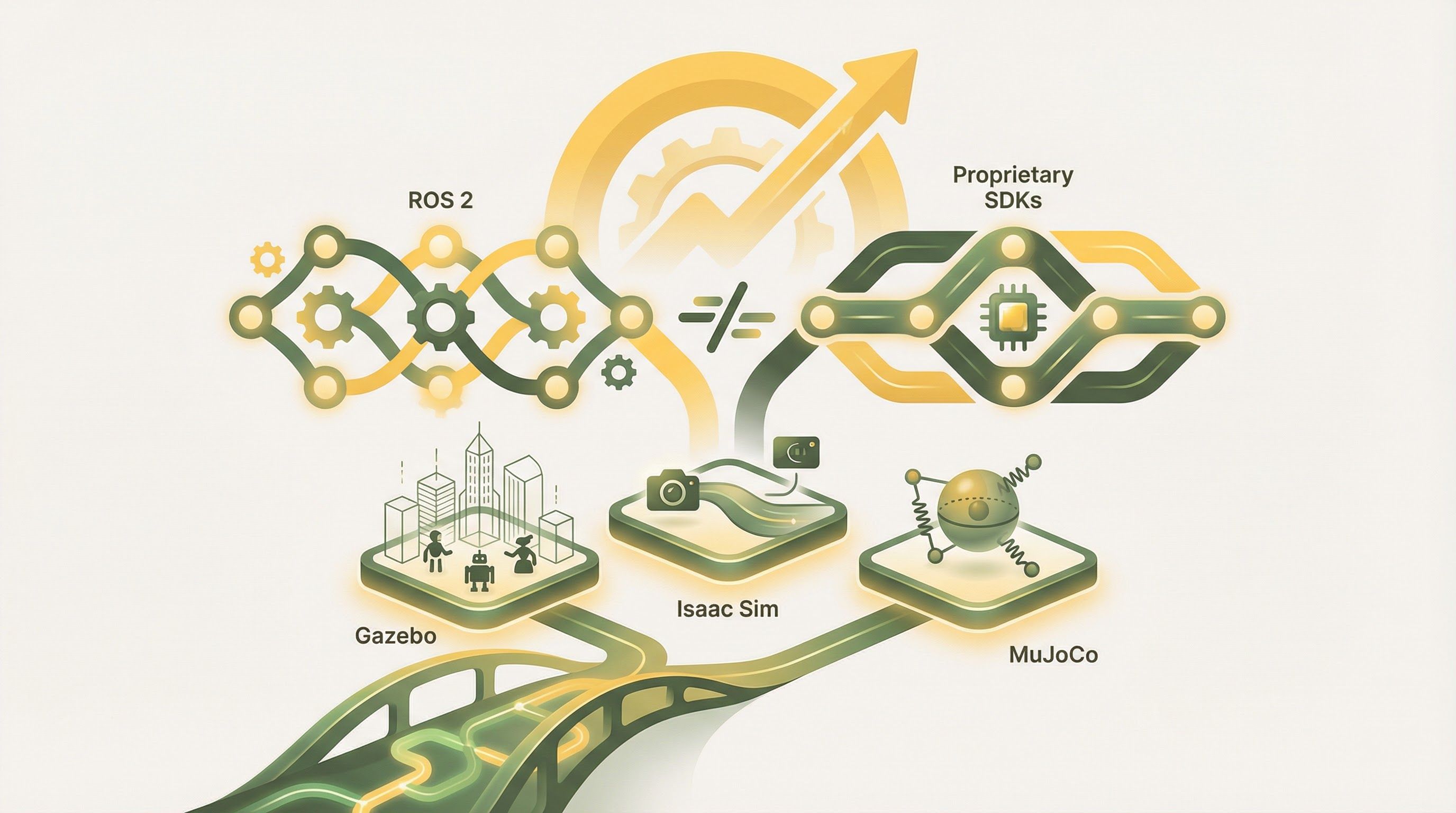
Understanding the Robotics Ecosystem: ROS 2 vs Proprietary SDKs
Before diving into development, beginners must understand the fundamental choice between the Robot Operating System 2 (ROS 2) and proprietary software development kits.
ROS 2 serves as the industry-standard middleware framework, providing a collection of libraries, tools, and conventions for building robot applications. According to ROS 2 Documentation, it offers real-time capabilities, multi-platform support (Linux, Windows, macOS), and a massive ecosystem of community-contributed packages. The r/ROS subreddit community of 35,000 members provides active support for newcomers.
Proprietary SDKs from manufacturers like Unitree, Boston Dynamics, and ABB offer tighter hardware integration but limit flexibility. For example, Unitree's Go2 EDU model at $14,500 includes full SDK access and ROS 2 support, while their consumer-grade Go2 Air at $1,600 relies on proprietary interfaces.
The strategic recommendation for beginners is to start with ROS 2 for maximum portability and career applicability. Proprietary SDKs make sense only when working with specific commercial platforms that require them.
| Criteria | ROS 2 | Proprietary SDK |
|---|---|---|
| Learning Curve | Steeper initially | Platform-specific |
| Community Support | 35,000+ active members | Vendor-dependent |
| Hardware Compatibility | Broad ecosystem | Single manufacturer |
| Career Applicability | Industry standard | Limited to vendor |
| Cost | Free and open source | Often bundled with hardware |
As this comparison shows, ROS 2 provides the foundation most employers expect, while proprietary tools serve specific industrial applications.
Choosing Your Simulation Environment: Gazebo, Isaac Sim, or MuJoCo
Simulation is where every robotics journey should begin. Testing algorithms in virtual environments before deploying to expensive hardware saves money, accelerates learning, and prevents damage to physical robots.
Gazebo (gz-sim)
Gazebo represents over 16 years of development in robotics simulation. According to the Gazebo GitHub repository, it offers high-fidelity physics, rendering, sensor models, and multiple entry points including GUI, plugins, and message passing. With 1,200+ GitHub stars, Gazebo remains the most widely adopted simulator for ROS-based development.
Best for: ROS 2 learners, educational institutions, and researchers requiring proven stability.
NVIDIA Isaac Sim / Isaac Lab
Isaac Lab is a GPU-accelerated, open-source framework built on NVIDIA Isaac Sim. With 6,370 GitHub stars, it supports reinforcement learning, imitation learning, and motion planning with 30+ ready-to-train environments and 16+ robot models. The Isaac Lab paper on arXiv details its capabilities for multi-modal robot learning.
Best for: AI/ML researchers, those with NVIDIA GPUs, and anyone focusing on learning-based robotics.
MuJoCo
Originally developed by Emo Todorov and now maintained by DeepMind, MuJoCo excels at fast contact dynamics simulation. Its popularity in reinforcement learning research stems from computational efficiency and accurate physics modeling.
Best for: Reinforcement learning practitioners and researchers requiring fast iteration cycles.
Webots
Webots provides a comprehensive 3D robotics simulator widely used in education. Its user-friendly interface makes it accessible to complete beginners, though it may lack some advanced features found in Isaac Sim.
Best for: Absolute beginners and K-12 educational settings.
The Beginner's Tech Stack: Python, C++, and Essential Libraries
Two programming languages dominate robotics development: Python for rapid prototyping and C++ for performance-critical applications. ROS 2 supports both, allowing developers to choose based on requirements.
Python offers faster development cycles and easier debugging. Most tutorials, including the popular Robotics & ROS 2 Essentials course with 2,197 GitHub stars, use Python for initial learning. Libraries like NumPy, OpenCV, and TensorFlow integrate seamlessly with Python-based robotics workflows.
C++ becomes essential when real-time performance matters. Production robotics systems, especially those involving motion control or sensor processing, typically use C++ for latency-sensitive components. The ROS 2 core itself is written in C++.
Essential libraries for beginners include OpenCV for computer vision and image processing, NumPy for numerical computing and linear algebra, TensorFlow or PyTorch for machine learning integration, and Nav2 for navigation and path planning. These tools form the foundation of modern robotics development regardless of your specialization.
From Simulation to Reality: Navigating the Sim2Real Gap
The "Sim2Real gap" represents one of robotics' most persistent challenges. According to IEEE ICRA 2025, discrepancies between simulated models and physical realities include dynamic differences in robot behavior, sensor variations between virtual and real-world measurements, and environmental variability that simulations cannot fully capture.
The 4th Robotic Sim2Real Challenge at ICRA 2025 focused specifically on mobile manipulation and flying robot tracks, highlighting ongoing research efforts to bridge this gap.
Practical strategies for managing Sim2Real transfer include domain randomization, where simulation parameters are varied during training to make policies robust to real-world variations. System identification involves measuring actual robot dynamics and adjusting simulation parameters to match. Incremental deployment means testing simple behaviors first before attempting complex maneuvers. Finally, sensor calibration ensures real sensors match their simulated counterparts through careful measurement and adjustment.
Hardware Platforms for Every Budget
Physical hardware represents a significant investment. The following table presents options across budget levels based on current market data:
| Platform | Price | Key Features | Target Audience |
|---|---|---|---|
| Arduino Starter Kit | $50-100 | Basic electronics, sensors, motors | Absolute beginners |
| Raspberry Pi 4 Kit | $75-150 | General-purpose computing, GPIO | Programming-focused learners |
| Elegoo Smart Robot Car | $80-120 | Pre-assembled, line following, obstacle avoidance | Young learners, hobbyists |
| TurtleBot 4 Lite | $1,700 | ROS 2 native, OAK-D-LITE camera, RPLIDAR | Budget-conscious ROS learners |
| TurtleBot 4 Standard | $2,600 | ROS 2 native, OAK-D-PRO camera, enhanced sensors | Education and research |
| Unitree Go2 Air | $1,600 | Quadruped, basic capabilities | Hobbyists entering quadruped robotics |
| Unitree Go2 Pro | $2,800 | 4D LiDAR, dual cameras, voice commands | Enthusiasts and intermediate users |
| Unitree Go2 EDU | $14,500 | Full SDK access, ROS 2 support, Jetson Orin | Institutions and research labs |
This range shows that meaningful robotics learning can begin with under $100 investment in electronics fundamentals before scaling to professional-grade platforms.
No-Code and Visual Programming Alternatives
Not everyone needs to master Python or C++ to participate in robotics. Visual and no-code tools are democratizing access to robotic systems.
ABB's AppStudio enables drag-and-drop robot interface programming without traditional coding. ROSBLOCKS provides visual ROS 2 programming through a Scratch-like interface, making robotics concepts accessible to younger learners. Educational platforms like Codino offer block-based programming specifically designed for robotics education.
For those building robotics-adjacent projects—dashboards, data visualization, control interfaces—YouWare enables complete web application development through natural language prompts. Rather than spending weeks learning web development, robotics learners can describe their needs and have functional interfaces generated in approximately 30 seconds.
Building Your Robotics Learning Dashboard with YouWare
Managing a robotics learning journey involves tracking progress, storing project data, and organizing resources. YouWare provides tools specifically suited to these needs without requiring web development expertise.
Project Documentation: YouWare's MCP integrations with GitHub and Notion allow robotics learners to maintain project documentation, code repositories, and learning notes in one unified platform. Describe what you need—"Create a project tracker with sections for simulation results, hardware tests, and learning notes"—and YouWare generates a complete application.
Data Management: The YouBase database module can store sensor logs, experiment results, and simulation data with built-in Time Travel functionality for tracking changes over time. This proves invaluable when debugging why a robot behaved differently between test runs.
Control Interfaces: Visual editing mode enables creating robot control dashboards with point-and-click editing. Robotics learners can build interfaces for monitoring robot status, visualizing sensor data, or controlling robot behavior without diverting attention from robotics fundamentals.
Team Collaboration: For robotics clubs or classroom settings, YouWare's Users & Authentication module enables building learning platforms with student logins and progress tracking—all without backend development knowledge.
The 12-Month Learning Roadmap
Based on analysis of programs like ThinkRobotics x Robocademy and open-source curricula, the following phased approach optimizes learning progression:
Phase 1: Foundation (Months 1-2)
Focus on Python programming basics, electronics fundamentals using Arduino or Raspberry Pi, and basic control theory concepts. Recommended resources include the Arduino Starter Kit for hands-on electronics experience and Python tutorials focusing on NumPy and basic automation.
Phase 2: Simulation Mastery (Months 3-4)
Learn ROS 2 fundamentals, Gazebo basics, URDF robot modeling, and sensor simulation. The Robotics & ROS 2 Essentials course provides hands-on exercises covering Docker, Gazebo simulation, SLAM, and autonomous navigation using the Andino robot.
Phase 3: Advanced Topics (Months 5-6)
Tackle SLAM and mapping algorithms, path planning with Nav2, computer vision using OpenCV, and navigation stack implementation. Isaac Lab tutorials become relevant here for those interested in learning-based approaches.
Phase 4: Sim2Real Transition (Months 7-8)
Begin hardware integration with platforms like TurtleBot 4 or custom builds. Focus on sensor calibration, real-world testing protocols, and debugging physical systems. This phase bridges simulation expertise to practical robotics.
Phase 5: Specialization (Months 9-12)
Choose a specialization based on interest: reinforcement learning with Isaac Lab and MuJoCo, humanoid robotics following Unitree's advancements, autonomous vehicles, or AI integration. The ThinkRobotics program offers weekly content updates covering these advanced topics.
Career Outlook: Jobs, Salaries, and In-Demand Skills
The financial rewards of robotics expertise are substantial and growing. According to the Careers in Robotics Hiring Report, Robotics Software & AI roles command a median salary of $195,000, while Transportation & Autonomous Vehicles positions average $199,300.
Skills premiums tell an even more compelling story. LinkedIn analysis indicates that AI and Machine Learning skills command salary premiums of 50-70%, with average salaries ranging from $187,000 to $214,000 for practitioners with these capabilities.
The AI robots market itself is valued at $20.51 billion in 2025 and projected to reach $124.26 billion by 2034 at a 22.16% compound annual growth rate according to Xtended View. This growth ensures sustained demand for qualified professionals across the entire robotics stack.
Online Communities and Learning Resources
The robotics learning community has never been more accessible. The r/robotics subreddit with over 317,000 members provides a welcoming environment for beginners to ask questions and share projects.
Key resources for self-directed learning include the official ROS 2 tutorials for systematic framework learning, the Henki Robotics open-source course providing Master's level curriculum, the MuJoCo Tutorial repository with 313 stars for reinforcement learning focus, and the Isaac Lab documentation for GPU-accelerated simulation.
For structured learning with industry recognition, the ThinkRobotics x Robocademy 6-12 month program covers ROS 2, NVIDIA Isaac, reinforcement learning, SLAM, humanoid robots, and self-driving cars with weekly content updates.
FAQ
What programming language should I learn first for robotics?
Start with Python for its gentle learning curve and extensive robotics library support. Python enables rapid prototyping and is the primary language used in most robotics tutorials and courses. As you progress and encounter performance-critical applications, gradually introduce C++ for real-time control systems. Both languages are supported by ROS 2, so skills transfer seamlessly.
How much does it cost to get started with robotics?
Meaningful robotics learning can begin with under $100 using Arduino or Raspberry Pi kits for electronics fundamentals. Simulation environments like Gazebo and MuJoCo are completely free. For physical robot platforms, budget options like TurtleBot 4 Lite at $1,700 or Unitree Go2 Air at $1,600 provide professional-grade learning experiences. Many learners spend 3-4 months in pure simulation before investing in hardware.
Do I need a powerful computer for robotics simulation?
Basic simulations run adequately on modern laptops. Gazebo operates on standard hardware with integrated graphics for simple scenarios. However, NVIDIA Isaac Sim requires a dedicated NVIDIA GPU (RTX 2070 or better recommended) for its GPU-accelerated features. Consider starting with Gazebo on existing hardware, then upgrading if you pursue AI/ML-focused robotics work.
How can YouWare help with my robotics projects?
YouWare enables building robotics project dashboards, data visualization interfaces, and experiment tracking systems without coding. You can create web applications for monitoring robot sensor data, logging experiment results, and organizing learning resources through natural language prompts. The YouBase database stores sensor logs with Time Travel functionality for debugging, while MCP integrations connect to GitHub for code management and Notion for documentation.
Is ROS 2 worth learning in 2026?
Absolutely. ROS 2 remainsthe industry standard for robotics development with a community of 35,000+ active members. Major employers expect ROS proficiency, and the framework's real-time capabilities make it suitable for production systems. Proprietary alternatives exist but limit career portability. The 16+ years of Gazebo development and extensive package ecosystem make ROS 2 the practical choice for both learning and professional work.
Conclusion
The path from robotics beginner to competent practitioner has never been clearer. Starting with simulation environments like Gazebo or Isaac Sim, progressing through ROS 2 fundamentals, and eventually deploying to physical hardware represents a proven learning trajectory. The $90 billion industry offers compelling career opportunities with salaries exceeding $195,000 for AI-specialized roles.
Whether you choose the traditional programming path or leverage no-code tools like YouWare for project management and interfaces, the resources exist to support your journey. The viral demonstrations of backflipping humanoid robots are just the beginning—2026 marks the moment when robotics becomes accessible to anyone willing to learn.

References
- Global Growth Insights - Robotics Market Report
- Isaac Lab GitHub Repository
- Gazebo Simulation Official Site
- ROS 2 Documentation
- Robotics & ROS 2 Essentials Course
- MuJoCo Tutorial Repository
- Careers in Robotics Hiring Report
- Unitree Robotics Official
- ThinkRobotics x Robocademy Program
- IEEE ICRA 2025 Sim2Real Challenge
- ABB AppStudio Announcement
- The Daily Dot - Unitree Spring Festival Coverage