Will Vibe Coding Replace Developers? What the Industry Shift Actually Means for Tech Careers

Key Takeaways
Vibe coding will not eliminate developer jobs, but it is fundamentally reshaping what those jobs look like. According to the World Economic Forum's Future of Jobs Report 2025, while 92 million jobs will be displaced by 2030, 170 million new roles will emerge—a net gain of 78 million positions. Entry-level coding positions face the greatest disruption, with Stanford research showing a 20% employment drop for developers aged 22-25 since 2022. The developers who thrive will be those who master AI tools like YouWare while developing irreplaceable skills in system design, problem-solving, and technical leadership.
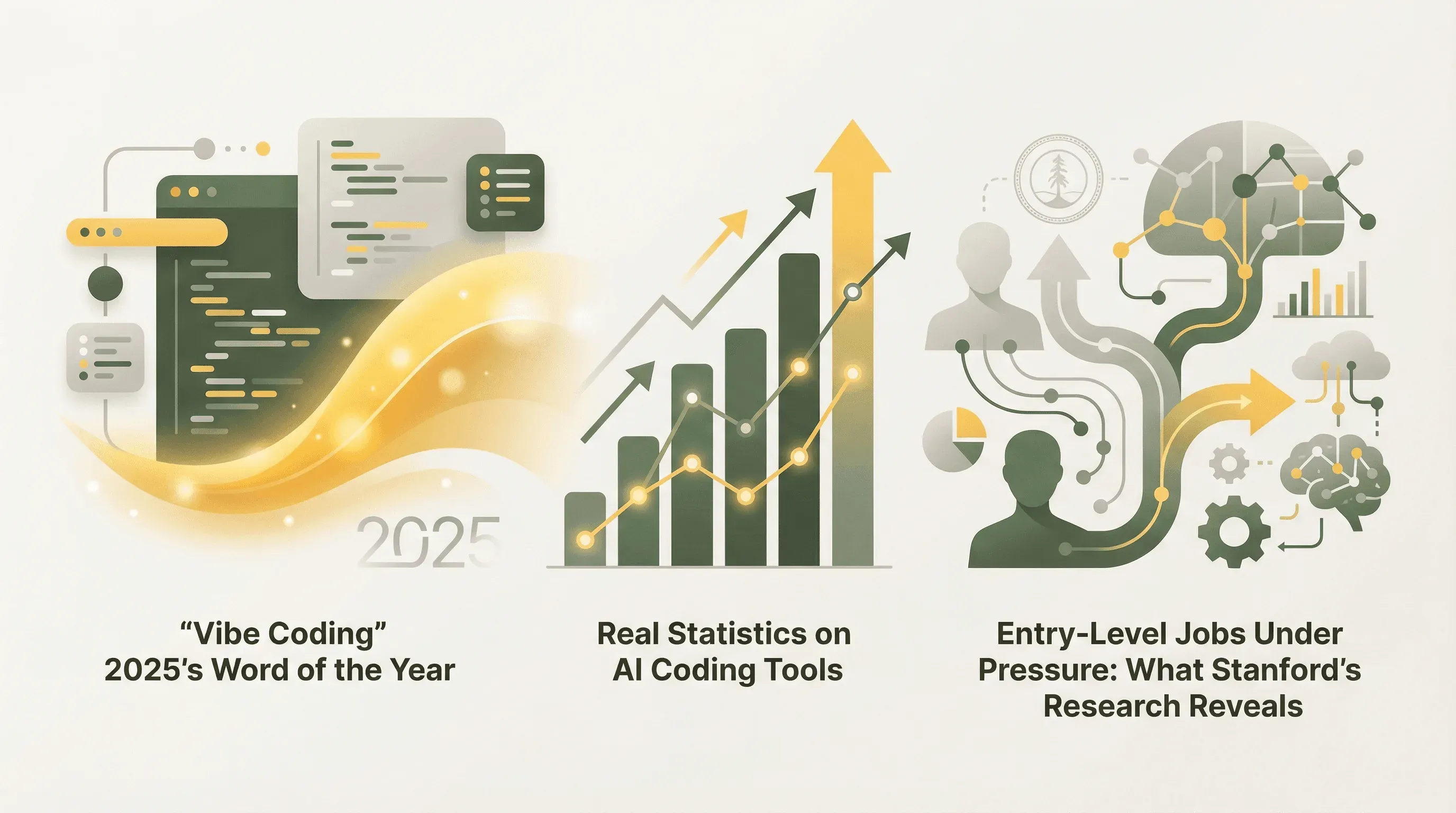 The rise of vibe coding is transforming how software gets built—and who builds it
Introduction
When Andrej Karpathy tweeted about "vibe coding" in February 2025, he probably didn't expect the term to become Collins Dictionary's Word of the Year. Yet here we are: a single phrase has crystallized the anxiety and excitement surrounding AI's impact on software development careers.
The headlines paint conflicting pictures. Google's CEO Sundar Pichai calls vibe coding "so much more enjoyable" and reveals that over 30% of Google's new code is now AI-generated. Meanwhile, developers scroll through LinkedIn watching colleagues announce layoffs, wondering if their skills have an expiration date.
The truth, as always, lies somewhere in the middle. This article cuts through the hype with actual data, expert perspectives, and practical career guidance. Whether you're a seasoned developer evaluating AI tools, a student questioning your major, or a career changer considering tech, you'll find an honest assessment of what the industry shift actually means for your future.
What Is Vibe Coding and Why Did It Become 2025's Word of the Year?
 Vibe coding enables developers to describe what they want in natural language while AI generates the code — Source: Unsplash
Vibe coding describes a development approach where you tell an AI what you want to build in plain English (or any language), and the AI generates the actual code. Instead of memorizing syntax or debugging semicolons, you describe the "vibe" of what you're creating—the functionality, the user experience, the desired outcome—and let machine learning handle the implementation details.
Karpathy, the former Tesla AI director and OpenAI researcher, coined the term to describe his own workflow shift. According to Business Insider, he predicts vibe coding will "terraform software and alter job descriptions" across the entire industry. That prediction is already playing out: GitHub Copilot has surpassed 20 million all-time users, with 90% of Fortune 100 companies now using the tool.
The term resonated because it captures something real about how development is changing. Traditional coding requires translating human intent into machine-readable instructions through precise syntax. Vibe coding inverts this relationship—you express intent naturally, and AI handles the translation. For many tasks, this works remarkably well. For complex architectural decisions, it still requires human oversight.
Platforms like YouWare have made this approach accessible to everyone. YouWare enables users to describe an application idea in natural language and generates a complete web application in approximately 30 seconds. The platform combines AI-powered code generation with visual editing, built-in database infrastructure through YouBase, and authentication systems—eliminating the traditional barriers between having an idea and launching a product.
The Numbers Behind the Hype: Real Statistics on AI Coding Tools
 Over 84% of developers now use or plan to use AI coding tools in their workflows — Source: Unsplash
The adoption statistics are staggering. According to ITPro, 84% of developers are now using or planning to use AI tools in their workflows—up from 76% in 2024. Enterprise usage of GitHub Copilot grew 13-fold over the past year, with over 50,000 organizations deploying the tool.
But adoption doesn't equal trust. The same ITPro survey found that 46% of developers distrust the accuracy of AI-generated outputs—up from 31% in 2024. This paradox defines the current moment: developers are using tools they don't fully trust because the productivity gains are too significant to ignore.
A UK Government study found that AI coding tools save developers an average of 56 minutes per working day—equivalent to 28 working days annually. Professional developers interviewed by Ars Technica report 10x speed improvements for certain tasks, though they remain divided on whether this is entirely good news.
Perhaps most surprisingly, a METR study found that experienced developers were actually 19% slower when using AI tools compared to working without them. This counterintuitive finding suggests that AI tools may benefit less experienced developers more than veterans who have already optimized their workflows.
| Metric | Statistic | Source |
|---|---|---|
| Developers using/planning to use AI tools | 84% | ITPro |
| Developers who distrust AI accuracy | 46% | ITPro |
| GitHub Copilot total users | 20+ million | TechCrunch |
| Fortune 100 companies using Copilot | 90% | TechCrunch |
| Average daily time saved | 56 minutes | UK DSIT Report |
| Google code that's AI-generated | Over 30% | Google CEO |
The data reveals a nuanced picture: AI coding tools are becoming ubiquitous, but trust lags behind adoption, and the benefits vary significantly based on experience level and task type.
Entry-Level Jobs Under Pressure: What Stanford's Research Reveals
 Entry-level developer positions have seen significant declines as AI handles routine coding tasks — Source: Unsplash
If there's one area where the data is unambiguous, it's the pressure on entry-level positions. A Stanford Digital Economy Lab study found a 13% decline in entry-level job listings over three years in sectors vulnerable to AI automation. More specifically, employment for developers aged 22-25 dropped nearly 20% from its 2022 peak by July 2025.
The logic is straightforward: entry-level tasks—writing boilerplate code, implementing standard features, fixing simple bugs—are precisely the tasks that AI handles well. When a senior developer can use AI to accomplish what previously required a junior team member, the economic incentive to hire that junior developer diminishes.
U.S. computer science job postings have decreased 35% from 2020 to 2025, according to Hakia, dropping from 1.3 million to 900,000 positions. According to CNBC, 41% of employers plan to reduce workforce as AI automates certain tasks, and employers have cited AI as a factor in nearly 55,000 job cuts in 2025.
This doesn't mean entry-level opportunities have vanished—they've transformed. AI-related developer roles increased from 2% to 10% of all developer positions between 2022-2024, according to Boundev. The Bureau of Labor Statistics still projects 17% employment growth for software developers from 2023-2030.
The implication for career starters is clear: the path into tech increasingly runs through AI literacy, not around it. Learning to work effectively with AI tools isn't optional—it's the new baseline competency.
Senior Developers' Perspective: The Good, The Bad, and The Technical Debt
 Senior developers increasingly focus on system design, code review, and AI oversight rather than line-by-line coding — Source: Unsplash
Senior developers occupy a unique vantage point in this transition. They have enough experience to evaluate AI output critically, yet they're also watching their roles fundamentally shift. The Ars Technica developer survey captures this ambivalence perfectly: developers largely agree AI coding tools work, but they're precisely worried because they work.
The productivity gains are real. Tasks that once took hours—writing unit tests, generating documentation, implementing standard patterns—can now be completed in minutes. One developer described it as having "a tireless junior developer who never gets frustrated with repetitive tasks."
But the concerns are equally real. InfoWorld warns that vibe coding without developer oversight creates "mountains of technical debt." AI can generate code quickly, but it lacks understanding of software complexity, architectural implications, and long-term maintainability. When companies prioritize speed over sustainability, they accumulate hidden costs that compound over time.
Senior developers are finding their roles shift from writing code to reviewing, architecting, and supervising AI output. This requires different skills: the ability to read code critically, spot subtle bugs that compile but fail in edge cases, and make architectural decisions that AI tools don't yet handle well. For many experienced developers, this evolution feels like a promotion—focusing on the high-value work they always wanted to do, while delegating the tedious parts.
The challenge is the "missing middle"—the mid-level developers who haven't yet developed senior-level judgment but are too experienced for entry-level tasks. This cohort faces the most uncertainty as roles are compressed from both directions.
The Skills That Matter Now: From Syntax to System Design
 System architecture and design thinking are becoming more valuable than memorizing syntax — Source: Unsplash
The World Economic Forum reports that nearly 40% of skills required on the job are set to change, with 63% of employers citing the skills gap as their primary barrier. This isn't just about learning new programming languages—it's about fundamentally different competencies.
What's becoming less valuable includes rote memorization of syntax and APIs (AI handles this efficiently), writing boilerplate and repetitive code patterns, and debugging simple errors that AI can identify and fix. These were never the most interesting parts of programming, but they represented a significant portion of junior developer responsibilities.
What's becoming more valuable encompasses a different set of capabilities. System design and architecture skills matter because AI struggles with decisions that require understanding business context, scalability requirements, and long-term maintenance implications. Problem decomposition becomes critical since the ability to break complex requirements into AI-manageable prompts is itself a skill. Code review and quality assessment require knowing what "good" looks like and remains essential for evaluating AI output. Domain expertise—understanding healthcare, finance, logistics, or other specific fields—helps developers specify requirements AI can implement. Finally, communication and collaboration skills become more important as translating between stakeholders and technical implementation becomes a core competency.
This shift actually opens doors for non-traditional candidates. As The Guardian reports, 43% of Gen Z workers anxious about AI are pivoting toward careers emphasizing "human skills"—creativity, interpersonal connection, and hands-on expertise. The best developers of the future may not be those who memorized the most algorithms, but those who best understand people and problems.
Computer Science Enrollment Decline: Are Students Making the Right Call?
 Computer science enrollment has declined as students question traditional paths into tech — Source: Unsplash
Computer science enrollment has declined 8.1% at the undergraduate level and 14% at the graduate level in 2025, according to National Student Clearinghouse data. The Computing Research Association reports that 62% of computing units expect declining enrollment for 2025-26. Students are clearly responding to market signals—but are they interpreting those signals correctly?
The case for concern is legitimate. If AI can write code, why spend four years learning to do it manually? The traditional pitch—learn to code, get a high-paying job—feels less certain when AI threatens to commoditize the skill that once commanded premium salaries.
But the case for continued CS education is equally strong. Understanding computer science fundamentals—algorithms, data structures, systems design—provides the foundation for evaluating AI output. You can't effectively supervise what you don't understand. The developers who will thrive aren't those who memorized syntax, but those who understand why certain approaches work and others don't.
More importantly, the curriculum is evolving. Forward-thinking programs are incorporating AI tool proficiency, prompt engineering, and human-AI collaboration into their coursework. The goal isn't to compete with AI at code generation—it's to develop the judgment and expertise that makes AI useful.
For students currently deciding, the question isn't whether to pursue CS, but how to approach it. Focus on fundamentals over frameworks, on understanding over memorization, and on building projects that demonstrate problem-solving rather than code-writing. The degree remains valuable, but its value lies in different skills than it did five years ago.
How No-Code Platforms Are Reshaping Career Paths
The rise of no-code and low-code platforms represents another dimension of this shift. Gartner forecasts that 70% of new applications will use low-code or no-code technologies by 2025, up from just 25% in 2020. The low-code market is projected to reach between $26.30 and $37.39 billion in 2025, according to Mordor Intelligence, growing to $31.59-$48.91 billion in 2026.
This growth isn't eliminating developer jobs—it's creating new categories of "citizen developers" and changing what professional developers focus on. When business users can build their own simple applications, professional developers handle the complex integrations, custom functionality, and architectural decisions that no-code tools can't address.
YouWare exemplifies this evolution. The platform combines natural language project creation with sophisticated backend infrastructure. YouBase provides database, authentication, and storage capabilities without requiring backend expertise. Visual editing mode allows precise adjustments without coding knowledge. MCP integrations connect projects to professional tools like GitHub, Figma, and Notion.
For developers, platforms like YouWare aren't competition—they're leverage. A developer using YouWare can prototype and iterate faster, focusing creative energy on solving problems rather than implementing boilerplate. For non-developers—marketers, entrepreneurs, product managers—these platforms provide genuine capability to build functional applications, reducing dependency on engineering resources for simpler projects.
The career implication is that the boundary between "developer" and "non-developer" is blurring. The future likely holds a spectrum of technical capability, from no-code users building simple tools to traditional developers handling complex systems, with various gradations in between.
The Realistic Career Outlook: What Industry Experts Actually Predict
Cutting through the hype requires distinguishing between what AI can do now, what it might do soon, and what remains firmly in the realm of human expertise.
AI currently handles routine coding tasks efficiently: generating boilerplate, writing tests from specifications, implementing standard patterns, and catching common bugs. It accelerates tasks that previously consumed significant developer time. However, AI currently struggles with novel architectural decisions, complex system integrations, understanding nuanced business requirements, and maintaining large codebases over time. These limitations aren't temporary—they reflect fundamental differences between pattern matching (which AI excels at) and reasoning about complex systems (which humans do better).
The realistic outlook isn't mass unemployment or business as usual—it's transformation. The World Economic Forum projects 92 million jobs displaced by 2030, but 170 million new roles created—a net increase of 78 million jobs. The question isn't whether there will be jobs, but whether your skills match the jobs that exist.
For existing developers, this likely means working with AI tools becomes mandatory, focus shifts toward architecture and oversight, and domain expertise becomes differentiating. For career changers, it means lower barriers to entry for building applications, greater emphasis on problem-solving over coding, and opportunities in AI tool development and integration. For students, it means fundamentals matter more than frameworks, building projects matters more than certifications, and AI literacy is now a baseline expectation.
Actionable Steps: How to Future-Proof Your Developer Career
 Future-proofing your career means embracing AI tools while developing skills that machines cannot replicate — Source: Unsplash
Based on the data and expert perspectives, here are concrete steps for different career stages.
If you're an experienced developer, start by mastering AI tools today. Use GitHub Copilot, Cursor, or similar tools daily. Learn their strengths and limitations through practice, not theory. The UK Government study shows 56 minutes saved daily—that's productivity you're leaving on the table. Then shift focus toward architecture: volunteer for system design discussions, practice explaining technical decisions to non-technical stakeholders, and develop the judgment that comes from seeing systems evolve over time. Finally, build domain expertise by choosing an industry vertical—healthcare, finance, e-commerce—and developing deep knowledge that makes you irreplaceable in that context.
If you're just starting your career, learn fundamentals deeply by understanding why code works, not just how to write it. Study algorithms, data structures, and systems design even as you use AI tools. Build publicly by creating projects that demonstrate problem-solving ability and sharing your process on GitHub, Twitter, or a blog. Develop complementary skills in communication, project management, and domain knowledge that compound with technical ability. Use tools like YouWare to accelerate learning—building complete applications quickly helps you understand full-stack development faster than traditional tutorials.
If you're considering a career change, start building immediately using no-code and low-code tools to create functional applications. This builds intuition for what's possible before investing in deeper technical education. Focus on problems you understand—your existing domain expertise becomes an asset when combined with technical capability. Learn to collaborate with AI, as prompt engineering and AI supervision are themselves valuable skills.
FAQ
Will AI completely replace software developers?
No. The data consistently shows transformation rather than elimination. While entry-level coding tasks are increasingly automated, the World Economic Forum projects a net gain of 78 million jobs by 2030. Developers who adapt—focusing on architecture, problem-solving, and AI collaboration—will remain valuable. The role is changing, but demand for people who can build, maintain, and improve software systems continues to grow.
Is it still worth learning to code in 2026?
Yes, but with different priorities. Understanding code remains essential for evaluating AI output, designing systems, and solving complex problems. The emphasis should shift from memorizing syntax to understanding fundamentals, from writing boilerplate to architectural thinking. Platforms like YouWare demonstrate that you can build applications without traditional coding, but the most capable builders will understand both AI tools and underlying principles.
How do I know if my job is at risk from vibe coding?
Roles most at risk involve repetitive, well-defined tasks: writing boilerplate code, implementing standard features, basic bug fixing. Roles least at risk require judgment, creativity, and system-level thinking: architecture, complex problem-solving, stakeholder communication. Evaluate your current responsibilities honestly: if AI could reasonably handle 80% of your daily tasks, it's time to evolve.
What skills should developers prioritize learning now?
System design and architecture top the list, followed by effective AI tool usage and prompt engineering, domain expertise in a specific industry, communication and stakeholder management, and code review and quality assessment. The common thread is judgment—knowing what to build, why to build it, and whether the result is good.
Can non-technical people build real applications with vibe coding?
Yes, with important caveats. Tools like YouWare enable non-technical users to create functional web applications through natural language prompts, complete with databases, authentication, and professional designs. For simpler applications—landing pages, internal tools, MVPs—non-technical builders can absolutely deliver. For complex, scalable systems, developer expertise remains essential for architecture, security, and long-term maintenance.
Conclusion
Vibe coding isn't ending software development careers—it's accelerating their evolution. The developers who thrive won't be those who resist AI tools, but those who master them while developing irreplaceable human skills: judgment, creativity, domain expertise, and the ability to navigate ambiguity.
The data tells a nuanced story. Entry-level positions face real pressure, but new roles are emerging faster than old ones disappear. Productivity tools save time, but trust hasn't caught up with adoption. The future belongs to developers who can leverage AI effectively while providing the oversight, architecture, and problem-solving that machines can't replicate.
Whether you're a seasoned developer, a student, or a career changer, the path forward is the same: embrace AI tools, develop complementary skills, and focus on the work that creates genuine value. The industry is changing, but the need for people who can turn ideas into working software has never been greater.

References
- World Economic Forum - Future of Jobs Report 2025
- Stanford Digital Economy Lab Study via Tom's Hardware
- Ars Technica - Developers Say AI Coding Tools Work
- Business Insider - Andrej Karpathy on Vibe Coding
- TechCrunch - GitHub Copilot 20 Million Users
- InfoWorld - IsVibe Coding the New Gateway to Technical Debt?
- UK DSIT Report via Public Technology
- ITPro - Developer Trust in AI Tools
- The Guardian - AI and Career Changes
- CNBC - Employers Plan to Use AI to Replace Roles
- Gartner Low-Code Forecast via Kissflow
- Mordor Intelligence - Low-Code Market Report
- National Student Clearinghouse - Enrollment Data