OpenClaw + YouWare: The Complete Guide to No-Code AI Agent Orchestration

TL;DR
AI agent orchestration allows multiple specialized AI agents to work together autonomously, handling complex tasks that single AI models cannot accomplish alone. OpenClaw, an open-source framework with over 145,000 GitHub stars, enables powerful multi-agent workflows but traditionally requires technical expertise to deploy. YouWare democratizes access to these capabilities through its AI-powered, no-code development platform—allowing anyone to build sophisticated agent systems using natural language prompts, visual editing, and built-in backend infrastructure.
AI agents serve as intelligent bridges between systems, autonomously coordinating tasks and data flows — Source: IBM
What Is AI Agent Orchestration? Understanding the Multi-Agent Revolution
AI agent orchestration represents a fundamental shift in how artificial intelligence systems operate. Rather than relying on a single AI model to handle every aspect of a complex task, orchestration coordinates multiple specialized agents—each with distinct capabilities—to work together toward a common goal. According to IBM, AI agents distinguish themselves from traditional large language models through their ability to use tool calling on the backend to obtain up-to-date information, optimize workflows, and create subtasks autonomously.
The enterprise adoption of multi-agent systems has accelerated dramatically. According to CrewAI, their platform alone processes over 450 million agentic workflows per month, with according to CrewAI's enterprise case studies, 60% of Fortune 500 companies now using their technology for AI agent orchestration. This represents a maturation point for the technology—moving from experimental projects to production-grade enterprise infrastructure.
Learning agents continuously improve through feedback loops, adapting to new patterns and optimizing performance — Source: IBM
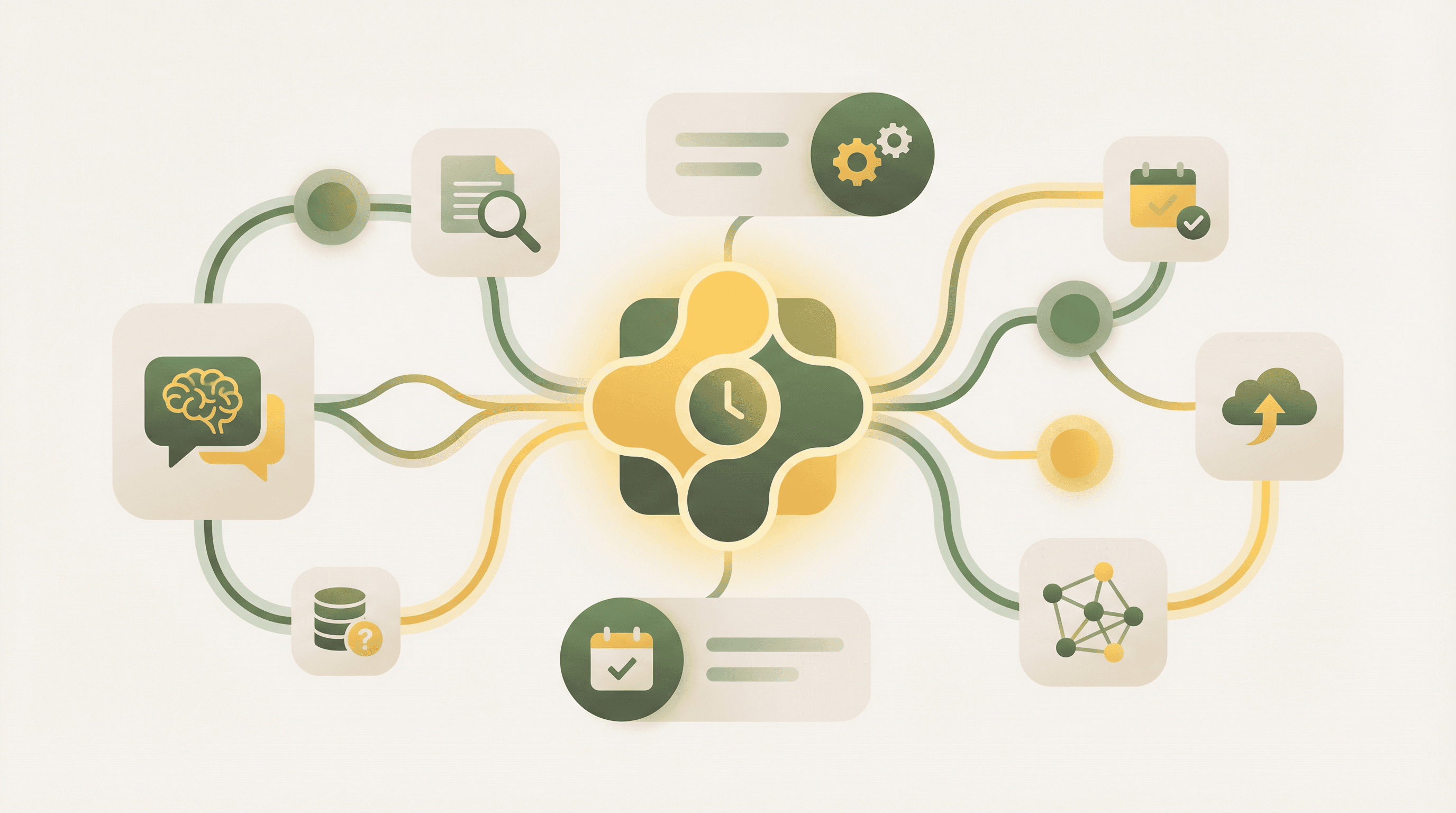
The core components of agent orchestration include the orchestrator (which coordinates agent activities), individual agents (specialized for specific tasks), shared memory and context systems, tool integrations for external actions, and governance layers for security and compliance. When these components work together effectively, organizations achieve remarkable results: according to CrewAI case studies, General Assembly achieved a 90% reduction in development time for curriculum design, while PwC improved code generation accuracy from 10% to 70%—a 7x improvement—using agentic workflows.
What Is OpenClaw? The Open-Source Framework Powering Modern AI Agents
OpenClaw is a free, open-source AI agent framework that has become one of the fastest-growing projects in the AI ecosystem. Originally released as Clawdbot in November 2025 by developer Peter Steinberger, the framework has attracted over 145,000 GitHub stars and 20,000 forks, according to openclaw-ai.dev. Unlike cloud-only AI chatbots, OpenClaw agents run entirely on local machines, connecting to any large language model—Claude, GPT, DeepSeek, or self-hosted open-weight models.
What makes OpenClaw particularly powerful is its messaging-first approach. Users can interact with their agents through familiar platforms like Telegram, Signal, WhatsApp, Discord, Slack, and iMessage. This means you can text your agent from your phone and have it manage emails, update calendars, scrape the web, generate reports, or orchestrate multi-step workflows—all while maintaining complete data privacy since everything runs locally.
Multi-agent architecture with central orchestration connecting AI models, tools, and governance layers — Source: Microsoft Learn
The OpenClaw ecosystem revolves around AgentSkills—modular plugins that extend agent capabilities. Over 100 community-built skills are available, covering everything from news aggregation and semantic memory to browser automation and CI/CD monitoring. The Archestra platform, described as "OpenClaw for Enterprise," adds additional capabilities including Kubernetes-native MCP orchestration, security sub-agents to prevent prompt injections, and cost monitoring that can reduce AI expenses by up to 96% through dynamic model optimization.
How YouWare Democratizes AI Agent Development
While OpenClaw provides powerful agent orchestration capabilities, it traditionally requires technical expertise to deploy effectively—you need to understand configuration files, manage API keys, set up messaging integrations, and handle deployment infrastructure. This is precisely where YouWare transforms the landscape.
AI agents process inputs through sophisticated models to generate intelligent, context-aware outputs — Source: Microsoft Learn
YouWare provides AI-powered development with natural language prompts, eliminating the need to write code for building multi-agent systems. Users describe their desired functionality in plain English—"Create an agent that monitors my email and summarizes important messages daily"—and YouWare generates the complete application, including backend infrastructure, database connections, and authentication systems.
The platform's multi-model switching capability mirrors the flexibility offered by professional agent orchestration platforms. YouWare supports OpenAI O3 Pro, GPT-4o, Claude Sonnet 4.5, Gemini 2.5 Pro, and DeepSeek V3, allowing users to choose the optimal model for each task. This parallels the model-agnostic design philosophy of OpenClaw, where agents can connect to any LLM based on task requirements.
Key Features That Enable No-Code Agent Development
YouWare combines several capabilities that make it uniquely suited for democratizing agent orchestration. YouBase provides built-in database, authentication, storage, and secrets management—the backend infrastructure typically required for production AI agents. This eliminates the need for separate database setup, API key management systems, or user authentication implementations.
The MCP (Model Context Protocol) integrations enable connection to external services like Figma, Notion, GitHub, Supabase, YouTube, and Google Maps—similar to how enterprise agent platforms connect to business systems. This extensibility means YouWare-built applications can interact with the same ecosystem of tools that power sophisticated orchestration platforms.
Visual editing mode combined with a code editor offers both no-code accessibility and code-level control. This approach mirrors what CrewAI calls their "no code/all code" philosophy, where users can start without technical expertise but aren't limited as their needs grow more sophisticated.
Building Your First Multi-Agent System Without Code
Creating an agent-powered application with YouWare follows a structured workflow that mirrors professional agent development practices while remaining accessible to non-technical users.
The agent development workflow from model selection through tool configuration to production deployment — Source: Microsoft Learn
The process begins with natural language specification. Using YouWare's Prompt Craft methodology—which structures prompts through feeling (vibe), story (narrative flow), and sculpture (iterative refinement)—users describe their agent's intended behavior. For example: "Create an application that monitors Hacker News for AI-related stories, summarizes the top five each morning, and sends them to my email with sentiment analysis."
Next, YouWare generates the application structure, including database tables for storing processed stories, authentication if needed, and the core logic. Users can then iterate conversationally—"Make the summaries more concise" or "Add a Slack notification option"—with the AI refining the implementation based on feedback.
The Plan Mode feature helps organize complex projects into structured steps before execution, analogous to how AI agents break down complex tasks into subtasks. For sophisticated multi-agent scenarios, this planning phase ensures all components work together coherently.
Finally, one-click publishing handles deployment without DevOps expertise. YouWare manages hosting, SSL certificates, and scaling—addressing the "deploy to production" challenge that often blocks agent projects from reaching real-world use.
Real-World Use Cases: From Customer Service to Content Automation
The combination of OpenClaw's orchestration patterns and YouWare's accessibility enables a wide range of practical applications.
AI-powered customer service represents one of the most impactful applications of multi-agent systems — Source: Zendesk
Customer Service Automation represents one of the highest-impact use cases. According to CrewAI case studies, Piracanjuba achieved 95% response accuracy for customer support using AI agent crews, while DocuSign achieved 75% faster first contact with leads using agents for data extraction and evaluation. With YouWare, users can build similar systems by describing their support workflow in natural language, with YouBase handling user data, conversation history, and escalation rules.
Content Creation and Publishing benefits from multi-agent coordination where one agent researches topics, another drafts content, and a third handles cross-platform publishing. The Multi-Platform Publisher skill from the OpenClaw ecosystem demonstrates this pattern—cross-posting content to Twitter, LinkedIn, and Bluesky with platform-specific formatting. YouWare's MCP integrations can connect similar workflows to content management systems and social platforms.
Research and Intelligence Gathering workflows leverage agents that aggregate information from multiple sources, apply semantic analysis, and generate actionable summaries. The combination of YouWare's Notion integration for knowledge management and its multi-model capability for analysis creates research assistants that rival enterprise solutions.
Internal Operations Automation addresses workflows like daily standup collection, report generation, and approval routing. n8n, a visual workflow platform with 500+ pre-built integrations, demonstrates similar patterns—YouWare offers comparable connectivity through its MCP tools while adding AI-native development capabilities.
The Expanding Agent Orchestration Ecosystem
Understanding the broader ecosystem helps contextualize how YouWare and OpenClaw fit into the rapidly evolving agent landscape.
LangGraph, developed by LangChain, provides a flexible framework supporting diverse control flows—single agent, multi-agent, hierarchical, and sequential—with built-in statefulness for human-agent collaboration. This represents the infrastructure layer that professional developers use when building custom orchestration systems.
Amazon Bedrock Agents enables multi-agent collaboration where specialized agents work together under supervisor coordination to address complex business workflows. This enterprise-grade solution demonstrates the governance and scalability requirements that large organizations demand.
Google's Vertex AI Agent Builder now supports the Agent2Agent (A2A) protocol with 50+ partners including Salesforce, ServiceNow, and UiPath for universal agent communication. The 100+ pre-built connectors available in the platform show the integration breadth required for enterprise adoption.
OpenAI's Operator, launched in January 2025, introduced Computer-Using Agent (CUA) capabilities that can autonomously navigate the web and perform tasks. This technology has since been integrated into ChatGPT as "agent mode," signaling that agent capabilities are becoming mainstream consumer features.
What YouWare uniquely provides is the accessibility layer atop these sophisticated orchestration patterns. While LangGraph requires Python expertise and Bedrock Agents demands AWS infrastructure knowledge, YouWare offers the same fundamental capabilities—multi-model support, tool integration, workflow orchestration, and production deployment—through natural language interaction.
Enterprise Considerations: Security, Scalability, and Governance
Production deployment of agent systems requires careful attention to security, scalability, and governance—areas where both OpenClaw and YouWare provide robust solutions.
Security concerns around AI agents center on data exfiltration and prompt injection attacks. The Archestra platform, building on OpenClaw's foundation, implements security sub-agents that isolate dangerous tool responses from the main agent to prevent prompt injections. Their non-probabilistic security model addresses the "lethal trifecta" of AI security risks documented in attacks on systems from ChatGPT to Notion.
YouWare addresses these concerns through its Secrets module, which stores API keys and sensitive credentials with enterprise-grade encryption at rest and in transit. Critically, secrets are server-side only—never exposed to frontend code—eliminating a common attack vector in agent applications.
For authentication, YouWare's built-in system supports email login with password management, Google OAuth integration, and temporary accounts for frictionless access. The user management dashboard provides statistics, daily trends, and the ability to block or unblock users—essential capabilities for applications handling sensitive operations.
Scalability is handled transparently through YouWare's publishing infrastructure. Users don't manage servers, load balancing, or database scaling—the platform handles infrastructure concerns while providing Time Travel and Bookmark features in YouBase for database recovery and version management.
Getting Started: Your Path from Concept to Production
The journey from idea to production-ready agent application with YouWare follows a clear progression that accommodates both beginners and experienced developers.
Step 1: Define Your Agent's Purpose. Start with a clear description of what you want your agent to accomplish. The more specific your description, the better YouWare's AI can generate appropriate structures. Consider the inputs (what triggers the agent), the processing(what analysis or actions it performs), and the outputs (what it produces or where it delivers results).
Step 2: Generate Initial Application. Use YouWare's natural language interface to create your project. Describe your agent's behavior, and the AI generates the complete application structure—frontend interface, backend logic, database tables, and any required authentication.
Step 3: Configure Integrations. Enable relevant MCP tools for your use case. If your agent needs to read from Notion, connect the Notion integration. If it needs to push code to GitHub, enable the GitHub connection. Each integration requires appropriate API credentials stored securely in YouBase Secrets.
Step 4: Iterate and Refine. Use conversational prompts to adjust behavior—"Make the notifications more detailed" or "Add error handling for failed API calls." The visual editing mode allows quick tweaks to UI elements without regenerating code. For advanced customization, the code editor provides direct access to the generated implementation.
Step 5: Test and Deploy. Preview your application across device sizes, test all workflows, and use the publish feature to generate a live URL. Configure privacy settings, enable or disable remixing, and optionally connect a custom domain for professional deployment.
FAQ
How does YouWare compare to CrewAI for building multi-agent systems?
CrewAI is a powerful Python-based framework designed for developers who want fine-grained control over agent orchestration, with impressive enterprise adoption (according to CrewAI, 60% of Fortune 500 companies use their technology). YouWare takes a different approach by enabling similar multi-agent patterns through natural language development, making these capabilities accessible to non-technical users. If you need maximum customization and have Python expertise, CrewAI offers deeper control. If you want to build agent-powered applications without coding, YouWare provides a faster path to production.
Can I use OpenClaw skills with YouWare?
While OpenClaw skills are designed for the OpenClaw framework specifically, YouWare achieves similar functionality through its MCP integrations and AI-powered code generation. Many patterns that OpenClaw skills implement—such as news aggregation, calendar sync, or web automation—can be replicated in YouWare by describing the desired behavior in natural language. For advanced users, YouWare's code editor allows implementing custom logic that mirrors skill functionality.
What happens to my data when using YouWare for agent applications?
YouWare stores application data in YouBase, with secrets encrypted at rest and in transit. Unlike OpenClaw, which runs entirely locally, YouWare is a cloud platform—but sensitive credentials are never exposed to frontend code and remain server-side only. For applications requiring complete local control, OpenClaw remains the appropriate choice; for applications benefiting from managed infrastructure and no-code development, YouWare provides a secure cloud-native alternative.
How much technical knowledge do I need to build agent applications with YouWare?
Zero coding knowledge is required to build functional agent applications with YouWare. The platform's natural language interface, visual editing mode, and pre-configured integrations handle technical complexity. However, YouWare also provides a code editor for users who want to make precise technical adjustments—offering a progression path from no-code to full code access as expertise grows.
What types of AI models can I use with YouWare?
YouWare supports multi-model switching between OpenAI O3 Pro, GPT-4o, Claude Sonnet 4.5, Gemini 2.5 Pro, and DeepSeek V3. This flexibility allows users to choose models based on task requirements—using faster models for simple operations and more capable models for complex reasoning. This mirrors OpenClaw's model-agnostic design, where agents can connect to any compatible LLM.
Conclusion
AI agent orchestration has evolved from an experimental technology to essential enterprise infrastructure, with platforms like OpenClaw demonstrating the power of multi-agent coordination and community-driven skill development. The challenge has always been accessibility—these powerful capabilities traditionally required significant technical expertise to deploy effectively.
YouWare bridges this gap by providing a no-code path to sophisticated agent applications. Through natural language development, built-in backend infrastructure via YouBase, extensive MCP integrations, and one-click publishing, YouWare enables anyone to build, deploy, and manage agent-powered applications that rival solutions built by experienced development teams.
Whether you're automating customer service workflows, creating content pipelines, building research assistants, or developing internal operations tools, the combination of proven orchestration patterns and accessible development tools means the barrier to entry has never been lower.
Ready to build your first AI agent application? Get started with YouWare today and transform your ideas into production-ready agent systems—no coding required.
References
- CrewAI - The Leading Multi-Agent Platform
- CrewAI Customer Success Stories
- LangGraph - Agent Orchestration Framework
- OpenAI Operator - Introducing Computer-Using Agents
- Amazon Bedrock Agents
- Google Vertex AI Agent Builder
- IBM - What Are AI Agents?
- n8n AI Agent Builder
- OpenClaw Community Hub
- Archestra - OpenClaw for Enterprise
- YouWare Documentation