How to Build a Valentine's Day Gift Recommendation Quiz (Tutorial)

TL;DR
Gift recommendation quizzes achieve a 40.1% lead conversion rate and can boost average order value by up to 369%, making them powerful tools for Valentine's Day sales. With the holiday expected to reach $29.1 billion in spending, interactive quizzes help small businesses and affiliates guide customers to perfect gifts through personalized questions. YouWare enables you to build a complete gift recommendation quiz in approximately 30 seconds using natural language prompts—no coding required.
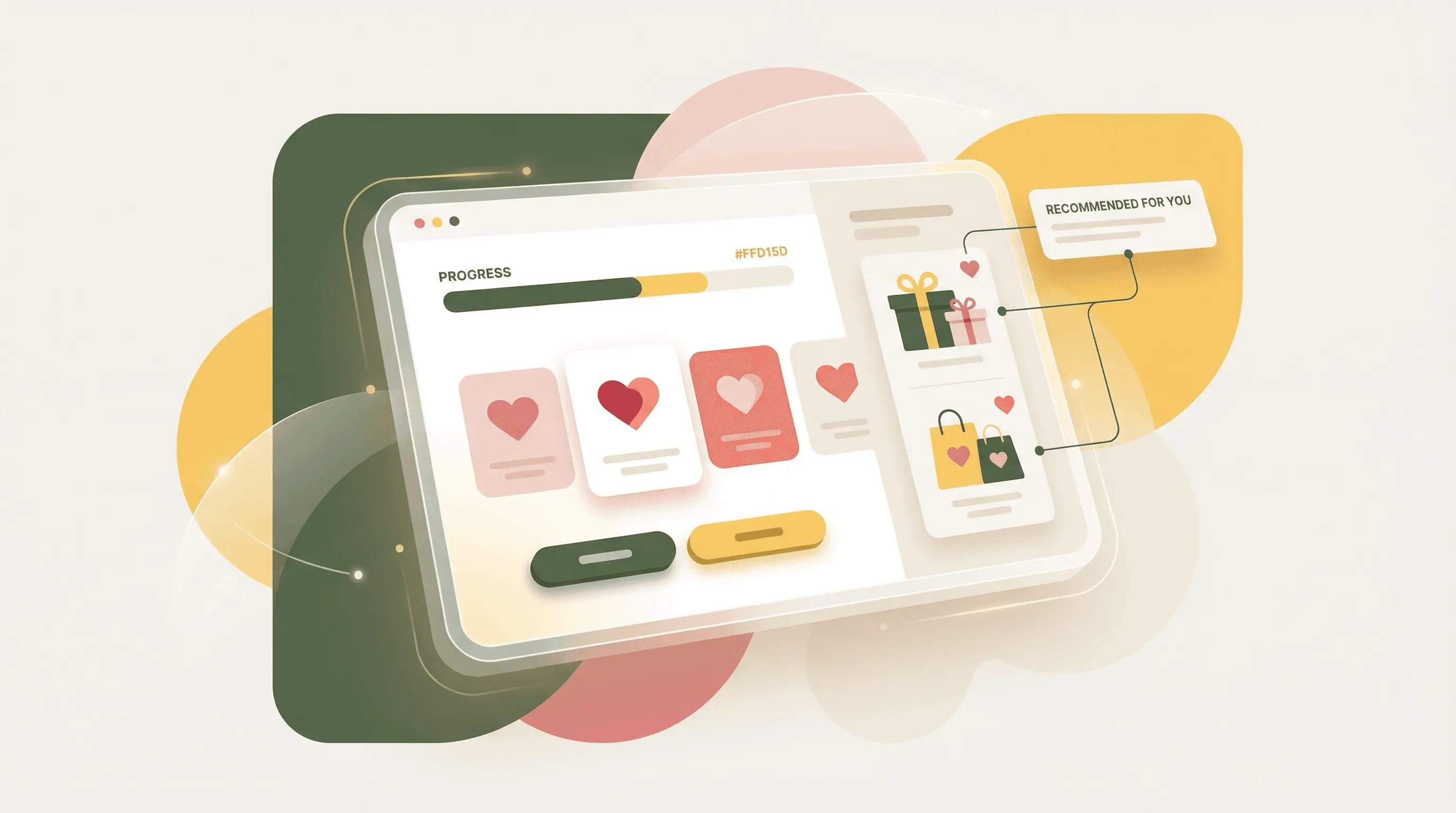 Interactive Valentine's Day gift recommendation quiz interface with personalized options
Introduction: Why Your Business Needs a Valentine's Gift Quiz
Valentine's Day represents one of the most lucrative opportunities for e-commerce businesses, with the National Retail Federation projecting record spending of $29.1 billion in 2026. Yet with 38% of shoppers preferring online purchases, the competition for attention has never been fiercer.
The challenge? Helping overwhelmed shoppers find the perfect gift among thousands of options. Traditional product pages force customers to browse endlessly, often leading to decision fatigue and abandoned carts. Gift recommendation quizzes solve this problem by transforming passive browsing into an engaging, personalized experience that guides customers directly to products they're most likely to purchase.
This tutorial walks you through building a Valentine's Day gift recommendation quiz using YouWare, a no-code platform that lets you create interactive web applications through simple natural language prompts. Whether you're a small business owner, affiliate marketer, or e-commerce entrepreneur, you'll have a working quiz ready to capture leads and drive sales.
Why Gift Recommendation Quizzes Drive Valentine's Day Sales
 Valentine's Day gifts beautifully wrapped, representing the $29.1 billion holiday shopping market — Source: Pexels
Interactive quizzes have emerged as one of the most effective conversion tools in e-commerce. According to Interact's Quiz Conversion Rate Report, quizzes achieve a 40.1% lead conversion rate—meaning 4 out of 10 participants willingly provide contact information after completing a quiz. This conversion rate has remained consistent since 2013, demonstrating the enduring effectiveness of quiz-based marketing.
The numbers become even more compelling when compared to traditional marketing approaches. Amra & Elma's research on interactive content found that quizzes convert leads at rates 70% higher than passive content like static forms or standard landing pages.
For Valentine's Day specifically, the stakes are high. The average consumer plans to spend $199.78 on Valentine's gifts in 2026, according to NRF data. Top spending categories include jewelry ($7 billion), dining experiences ($6.3 billion), clothing ($3.5 billion), and flowers ($3.1 billion). A well-designed quiz can intelligently route shoppers toward these high-value categories based on their answers.
Perhaps most importantly, quiz funnels collect what marketers call "zero-party data"—information that customers willingly provide about their preferences. According to Ecommerce Fastlane, this data is inherently more accurate than inferred behavioral data and builds trust with customers who appreciate transparency in how their information is used.
The Psychology Behind Personalized Gift Recommendations
 Romantic Valentine's setup showcasing the emotional connection that drives personalized shopping — Source: Pexels
Understanding why quizzes work so effectively requires examining the psychology of personalization. According to Number Analytics, 80% of consumers are more likely to make a purchase when brands offer personalized experiences. This preference for tailored recommendations reflects a fundamental shift in consumer expectations—shoppers no longer want to sift through generic catalogs.
The impact on business metrics is substantial. Barilliance's research on personalized product recommendations reveals that personalized recommendations can increase conversion rates by up to 288% compared to generic suggestions. Even more striking, personalized recommendations account for up to 31% of e-commerce site revenues on average.
Valentine's Day shopping carries unique emotional weight that amplifies these effects. Shoppers aren't just buying products—they're expressing love, appreciation, and connection. A quiz that asks thoughtful questions about the recipient creates an emotional investment in the process, making the final recommendation feel more meaningful than a random product suggestion.
The key insight from Revenue Hunt's guide on e-commerce quizzes is that limiting quizzes to 5-6 questions optimizes engagement while gathering sufficient data for accurate recommendations. This constraint forces you to identify the most important qualifying factors for your product catalog, resulting in more focused and effective recommendations.
Building Your Valentine's Gift Quiz with YouWare
 Product finder quiz template demonstrating modern, engaging quiz design patterns — Source: involve.me
YouWare transforms the traditionally complex process of building interactive quizzes into a straightforward conversation with AI. The platform generates complete web applications from natural language descriptions in approximately 30 seconds, eliminating the need for coding knowledge or expensive developer resources.
Prerequisites
Before starting, ensure you have the following ready:
- A YouWare account (the free tier works for basic quizzes)
- A list of gift categories or specific products you want to recommend
- Valentine's-themed images (optional—YouWare can generate these using built-in image generation with Midjourney or GPT-image-1)
Step 1: Create Your Project with Natural Language
Start by clicking "Create" in YouWare and describing your quiz concept. A detailed prompt yields better results. For example:
"Create a Valentine's Day gift recommendation quiz with 5 questions. Include questions about who the gift is for (partner, family, friend), their interests, budget range, style preference, and what matters most to them. Show a progress bar and use a romantic color scheme with reds and pinks. At the end, display personalized gift recommendations based on their answers."
YouWare generates the initial project structure in about 30 seconds, including the quiz interface, question flow, and recommendation logic.
Step 2: Design Your Quiz Questions
Effective quiz questions qualify shoppers while keeping them engaged. Based on SWAI Academy research, short quizzes with 5-10 questions achieve 80-90% completion rates, while longer quizzes with 20+ questions drop to 30-50% completion.
Here's a proven 5-question framework for Valentine's gift recommendations:
| Question | Purpose | Sample Options |
|---|---|---|
| Who are you shopping for? | Identifies relationship context | Partner, Family member, Friend, Colleague, Pet |
| What's their primary interest? | Narrows product category | Fashion, Tech, Experiences, Home & Living, Food & Drink |
| What's your budget? | Sets price parameters | Under $25, $25-50, $50-100, $100-200, $200+ |
| How would you describe their style? | Refines aesthetic preferences | Classic, Trendy, Minimalist, Bold, Cozy |
| What matters most to them? | Determines value proposition | Quality, Uniqueness, Practicality, Sentiment |
Each question should flow logically and feel conversational rather than interrogative. Use YouWare's Code Mode to refine question wording by prompting: "Make the quiz questions feel more conversational and friendly."
Step 3: Configure Quiz Logic and Recommendations
The power of a gift quiz lies in its conditional logic—routing different answer combinations to appropriate product recommendations. In YouWare, you can describe this logic naturally:
"Set up the following recommendation logic: If the user selects 'Partner' and 'Fashion' with budget over $100, recommend jewelry and designer accessories. If they select 'Friend' and 'Food & Drink' with any budget, recommend gourmet gift baskets or wine subscriptions. Create at least 8 different recommendation paths based on common answer combinations."
YouWare's AI-powered development interprets these instructions and generates the appropriate conditional statements automatically.
Step 4: Enable YouBase Database for Response Storage
Storing quiz responses enables valuable capabilities: retargeting based on preferences, analyzing popular gift categories, and personalizing return visits. YouWare's YouBase Database module handles this without external database setup.
Navigate to the YouBase tab and enable the Database module. Then prompt:
"Create a database table called 'quiz_responses' with columns for timestamp, recipient_type, interests, budget, style, priority, and recommended_products. Store each completed quiz submission in this table."
YouBase provides persistent structured storage with export capabilities, allowing you to analyze response patterns in spreadsheet applications or connect to external analytics tools.
Step 5: Add Optional Email Capture for Lead Generation
For businesses focused on building email lists, adding a lead capture step before revealing recommendations can dramatically improve marketing ROI. Interactive Form research shows SaaS quiz visitor-to-lead conversion rates ranging from 20% to 45%.
Enable YouBase Users & Authentication module, then prompt:
"Before showing the gift recommendations, display an email capture form that says 'Enter your email to see your personalized gift recommendations and receive exclusive Valentine's deals.' Make the form optional with a 'Skip' button."
YouWare supports email login with password management, Google OAuth integration, and temporary accounts for frictionless access—giving you flexibility in how much friction to introduce.
Step 6: Customize Design with Visual Editing
YouWare's Visual Editing mode allows point-and-click customization without touching code. Click any element to edit text, images, colors, or layout. For Valentine's theming, consider adjustments such as adding romantic color gradients transitioning from deep red to soft pink, incorporating heart-shaped icons or subtle animated hearts in the background, using elegant serif fonts for headers to convey romance and sophistication, and ensuring buttons have sufficient contrast and clear calls to action.
For more precise control, access the full source code editor with syntax highlighting and AI assistance. You can prompt specific changes like: "Add a subtle floating hearts animation in the background that doesn't distract from the quiz content."
Step 7: Optimize with Boost
Before publishing, use YouWare's Boost feature—a one-click AI optimization that analyzes and enhances page structure, content quality, and user experience while preserving your original design. Boost can improve load times, mobile responsiveness, and overall quiz flow based on best practices.
Step 8: Publish and Share
Click Publish to deploy your quiz with a shareable URL (e.g., valentinequiz.youware.app). YouWare handles hosting, SSL certificates, and scalability automatically. For Pro and Ultra plans, you can deploy under custom domain names for stronger branding.
Share your quiz URL across social media platforms, embed it in email campaigns, or integrate it into your existing website. The self-contained nature of YouWare projects makes distribution straightforward across any channel.
Successful Gift Quiz Examples from Leading Brands
 Quiz conversion funnel illustration showing how quizzes guide customers through the buying journey — Source: involve.me
Examining successful implementations provides inspiration for your own quiz design. According to OptiMonk's personalization quiz analysis, several brands have achieved remarkable results with quiz-based product recommendations.
Zenni Optical uses a face shape quiz to recommend eyeglass frames, reducing the overwhelming choice paralysis that comes with hundreds of frame options. Their quiz asks about face shape, personal style, and intended use (everyday, work, sports) to narrow recommendations to a curated selection. This approach directly addresses the friction of buying glasses online without trying them on.
Bearaby (weighted blankets) guides customers through questions about sleep preferences, temperature sensitivity, and aesthetic preferences. Rather than forcing customers to understand technical specifications like weight distribution and fabric breathability, the quiz translates preferences into product recommendations that match individual sleep needs.
Crown & Paw (custom pet portraits) uses quizzes to help customers choose portrait styles, backgrounds, and artistic treatments for their pet photos. The quiz creates an emotional journey that builds excitement for the final product while gathering the specific information needed for customization.
The common thread among successful quiz implementations is solving a genuine customer problem—helping people make confident decisions in categories where they lack expertise or face overwhelming options.
Measuring Quiz Performance: Key Metrics to Track
 Analytics dashboard displaying key quiz performance metrics and conversion data
Launching your quiz is just the beginning. Ongoing optimization based on performance data separates successful quiz funnels from underperforming ones. Focus on these key metrics:
Completion Rate measures the percentage of users who start the quiz and finish all questions. According to Interact, well-designed quizzes achieve approximately 65% completion rates. If your rate falls significantly below this benchmark, examine whether questions are confusing, the quiz feels too long, or technical issues cause abandonment.
Drop-off Analysis identifies where users abandon the quiz. YouWare's YouBase Database stores each response, allowing you to analyze patterns. If many users drop off at a specific question, that question may need rewording or the options may not resonate with your audience.
Lead Conversion Rate tracks how many quiz completers submit their email address (if you include a capture step). The Interact benchmark of 40.1% provides a target, though rates vary significantly based on the value proposition and friction level of your capture form.
Recommendation Click-Through Rate measures how many users click on recommended products after seeing their results. Low click-through suggests a disconnect between quiz logic and user expectations—the recommendations may not feel sufficiently personalized or relevant.
Revenue Per Quiz Completion connects quiz engagement directly to business outcomes. By tracking which recommendation paths generate the most revenue, you can optimize quiz logic to favor higher-converting or higher-margin recommendations.
Export quiz response data from YouBase periodically to analyze trends in spreadsheet applications or connect to business intelligence tools for deeper analysis.
Best Practices for Valentine's Quiz Success
Drawing from Digioh's technical guidance on quiz creation and SBDC's Valentine's marketing recommendations, these best practices maximize your quiz's effectiveness:
Launch Early: Start promoting your quiz at least 2-3 weeks before Valentine's Day. According to NRF data, 55% of consumers plan to celebrate Valentine's Day, and many begin shopping weeks in advance, especially for shipped items.
Mobile-First Design: With 38% of Valentine's shoppers preferring online purchases, many will encounter your quiz on mobile devices. YouWare's generated projects are responsive by default, but use Visual Editing to verify button sizes and text readability on smaller screens.
Clear Value Proposition: Communicate what users gain from completing the quiz. Phrases like "Find the perfect gift in 60 seconds" or "Get personalized recommendations matched to their personality" set expectations and motivate completion.
Honest Recommendations: Ensure your quiz logic produces genuinely helpful suggestions. Users quickly recognize when a quiz funnels everyone toward the same high-margin products regardless of answers. Trust, once broken, is difficult to rebuild.
Follow-Up Sequences: For users who provide email addresses, create automated follow-up sequences. Send their quiz results immediately, follow with additional recommendations 24 hours later, and include a reminder as Valentine's Day approaches.
A/B Test Systematically: Test different question wordings, recommendation presentations, and email capture placements. Small improvements in completion rate and conversion compound into significant revenue gains over time.
FAQ
How long does it take to build a gift recommendation quiz with YouWare?
YouWare generates the initial quiz structure in approximately 30 seconds from a natural language description. Refining the design, customizing quiz logic, and connecting database storage typically takes an additional 30-60 minutes depending on complexity. Most users can have a production-ready quiz live within a few hours, compared to weeks of development time for custom-coded solutions.
Do I need coding skills to create a quiz with YouWare?
No coding skills are required. YouWare interprets natural language prompts and generates the underlying code automatically. You describe what you want in plain English—"Add a progress bar at the top of the quiz" or "Change the button color to red"—and YouWare implements the changes. For users who do know code, full source code editor access is available for granular control.
Can I integrate the quiz with my existing e-commerce platform?
Yes, there are several integration approaches. You can embed the quiz using an iframe on your existing website, link directly to the YouWare-hosted quiz from your navigation or marketing campaigns, or use YouWare's MCP integrations to connect with external services. For product recommendations, you can include direct links to product pages on your e-commerce platform within the quiz results.
How do I ensure my quiz recommendations are accurate?
Accurate recommendations require thoughtful quiz design and ongoing refinement. Start by mapping your product catalog to distinct customer segments based on recipient type, budget, and preferences. Test your quiz logic by completing it multiple times with different answer combinations to verify sensible recommendations. Monitor quiz response data in YouBase to identify patterns, and adjust recommendation rules based on which products generate the highest engagement and conversion rates.
What's the ideal number of questions for a Valentine's gift quiz?
Research from Revenue Hunt and SWAI Academy consistently recommends 5-6 questions as the optimal range. This length gathers sufficient information for meaningful personalization while maintaining the 80-90% completion rates associated with shorter quizzes. Longer quizzes risk abandonment, while shorter quizzes may lack the data needed for accurate recommendations.
Conclusion: Turn Valentine's Browsers into Buyers
Valentine's Day represents a massive opportunity—$29.1 billion in consumer spending with average purchases approaching $200 per person. Gift recommendation quizzes help you capture a meaningful share of this market by solving the universal challenge of findingthe perfect present.
The data is compelling: 40.1% lead conversion rates, 288% higher conversion from personalized recommendations, and up to 31% of e-commerce revenue attributed to personalization. These aren't theoretical projections—they're proven benchmarks from years of quiz marketing research.
YouWare removes the traditional barriers to implementing quiz-based marketing. No developer hiring, no months of development time, no ongoing maintenance headaches. Describe your quiz in natural language, customize with visual editing, connect your database, and publish—all within hours rather than weeks.
Ready to build your Valentine's gift quiz? Get started with YouWare today and transform how your customers discover the perfect gift.
References
- National Retail Federation - Valentine's Day Spending Statistics
- Interact - Quiz Conversion Rate Report
- Barilliance - Personalized Product Recommendations Statistics
- Revenue Hunt - How to Build a Successful Ecommerce Quiz
- Ecommerce Fastlane - Product Recommendation Quiz Guide
- SWAI Academy - How Quiz Length Affects User Engagement Rates
- Amra & Elma - Interactive Quiz Statistics
- Number Analytics - Recommendation Systems in E-commerce
- OptiMonk - Personalization Quiz Examples
- Digioh - How to Make Product Recommendation Quiz
- SBDC - Valentine's Day Marketing for Small Businesses
- Interactive Form - Quiz Conversion Rate Benchmarks